


This story is part of our April 2026 issue. To read the print version, click here.
Nobody wants to spend weeks in a shoulder sling. But after a rotator cuff injury, it’s supposed to keep the joint stable long enough to heal. The problem is, slings are bulky and awkward, so patients slip them off to work or shower or get comfortable, raising the risk of re-injury.
Re-tears after rotator cuff repair is common, reported from between 13 and 94 percent of cases, which raises a big question: What if the sling itself is obsolete?
ImmobiCUFF, a medtech startup founded by five biomedical engineers at UC Davis, believes it is and has a solution designed to replace it.
The team developed an implantable device made of three dissolvable sutures placed under the shoulder. Each suture is a different length. For the first two weeks after surgery, the shortest suture holds the joint in place, allowing about 20 degrees of movement. When it dissolves, a longer suture takes over, increasing motion to about 40 degrees. Two weeks later, the final suture allows up to 60 degrees before dissolving, intended to restore full mobility to the patient.
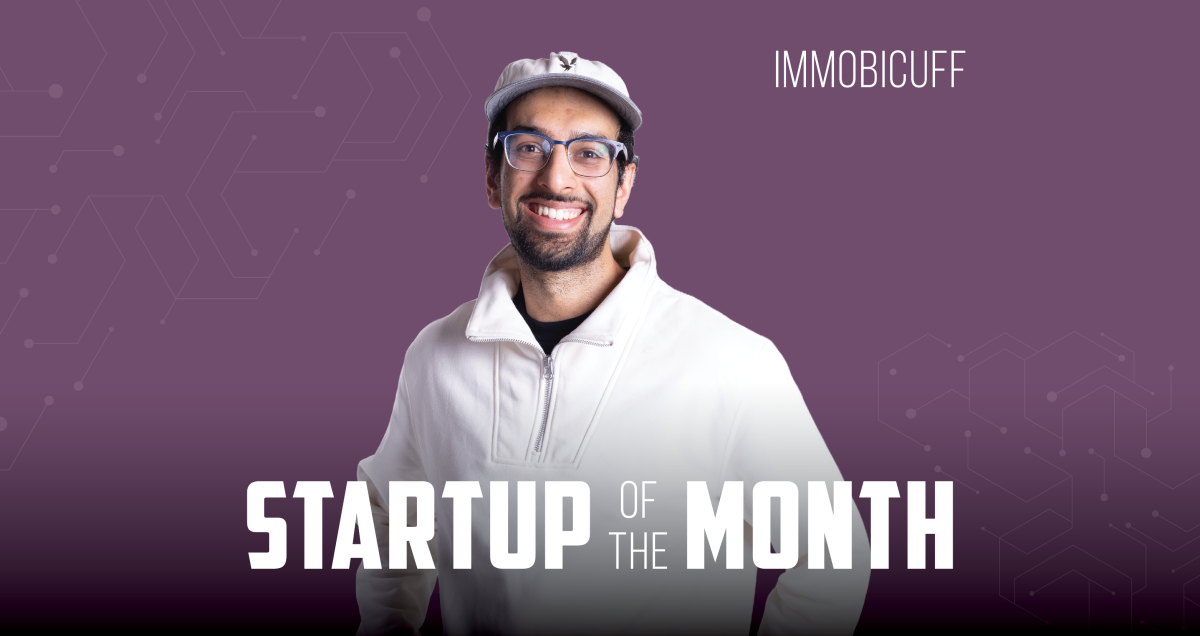
“The reason we developed it this way, in this six-week time frame, was to follow standard rehabilitation protocols,” says Saahil Sachdeva, co-founder and CEO of ImmobiCUFF.
The startup formed out of a clinical immersion program at Aggie Square, where undergraduates observe surgeries at the UC Davis Medical Center. The founding team includes Sachdeva, Veena Arunkumar, Cynthia Ju, Matthew Jue and Rohan Kumar.
They decided to focus on the rotator cuff because it’s a very common injury, with more than 500,000 patients going through a repair every year.
“On top of that, the surgeon himself was very willing to mentor us biomedical engineers and was willing to be our sponsor for the capstone project,” Sachdeva says, “which is why we’re able to move this project along and integrate it into our coursework.”
It was a typical engineering design process with the team in the library at a whiteboard drawing up ideas, says Matthew Jue. With the support of Jennifer Choi, associate professor of Teaching in Biomedical Engineering, and Dr. Kyle Walker, an orthopaedic surgeon at UC Davis Health, they came up with an implantable and resorbable device to improve patient recovery time and reduce the need for follow-up surgeries.
“With this idea of an implantable device, we had some challenges because this device has to both restrict shoulder motion like a sling, but it also has to allow for movement in the shoulder, so that patients can still do physical therapy,” Sachdeva says. “In our interviews, both immobilization with the sling and mobilization with physical therapy were very important to a better recovery for the rotator cuff.”
As the team’s mentor during their final year at UC Davis, Sophia Waxman supported them, arriving with a bachelor’s degree in Mechanical Engineering and her current PhD research related to textiles and fabrication. She helped them identify design flaws, acquire materials and guided them in testing.
“I believe that their final design is not only mathematically, but also practically sound,” Waxman says. “The team is well positioned and dedicated enough to make their design a reality in surgeries. They just need the support and recognition to do so.”
Because the device is implanted, it will require extensive verification testing and clinical trials to prove its safety and effectiveness. The team began the project in a capstone course with a $600 budget and now looks to raise funds to support manufacturing and early-stage testing. After speaking with so many different people, the team believes this device can impact many lives affected by rotator cuff injuries.
“In one case, we interviewed a grandma who is suddenly unable to lift her grandson following that sort of injury,” Sachdeva says. “And many people who get that injury can also be out of their job, especially in heavy labor industries.”
–
Stay up to date on business in the Capital Region: Subscribe to the Comstock’s newsletter today.
Recommended For You

Meet the Sacramento Founder Building a New Kind of Video Game Studio
Startup of the Month: An emerging Sacramento studio is blending game development with community-building for independent creators
After years in the esports and gaming industry, Jessica Flor launched Hexwave to create inclusive games and support indie developers.

This Sacramento Startup Wants to Help You File Your Property Taxes
Startup of the Month: LowPropTax developed an AI-powered tool to guide homeowners through property tax appeals
After dealing with multiple errors, David Webb, founder of LowPropTax, takes property taxes personally.
Startup of the Month: Alcheme Bio
Taking the bitterness out of plant-based proteins
For many, plant-based proteins leave a bad taste in the mouth: bitter and “beany,” according to Vanessa Small. At her food tech startup Alcheme Bio, she strips that tart taste at the cellular level to enhance flavoring.

Startup of the Month: Sortify
UC Davis team to help users throw trash away the right way
By the end of the 20th century, the Three Rs were everywhere: Reduce, Reuse, Recycle. But waste management is more complicated than a catchy slogan, according to Sambhav Agarwal, a third-year computer science student at UC Davis.