


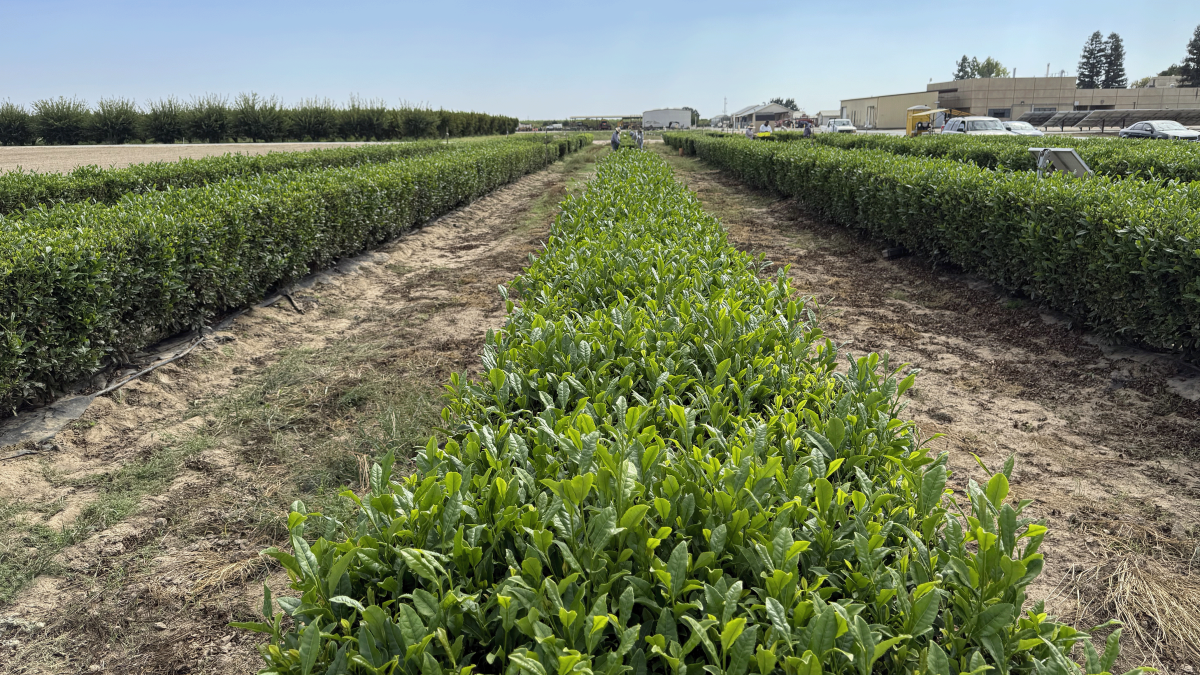
Three hours from Sacramento in Parlier, there’s a corner of the sprawling agricultural fields of the San Joaquin Valley dedicated to envisioning the future of agriculture in California. The Kearney Agricultural Research and Extension Center, or KREC, contains a greenhouse, a postharvest laboratory, a mosquito control laboratory, offices and 260 acres of orchards, vineyards and fields where research is conducted on nuts and fruits, such as blueberries, grapes and Southeast Asian fruits. This center, along with others run by the University of California Division of Agricultural and Natural Resources, advances knowledge on water conservation, irrigation techniques, best practices for farmers and policies affecting California.
Almost 60 years ago, a project funded by Lipton at KREC demonstrated that tea can thrive in California. But that project shuttered in the 1980s and was forgotten by most people at the university until it was rediscovered and revitalized in the 2010s. Next month, on March 20, 2026, KREC plans to host its first CA Tea Day, celebrating and sharing its recent work on tea cultivation. We spoke to scientists and researchers associated with the project to get a better sense of the work that went into their first crop.
Can tea grow in California?
In 1967, the tea giant Lipton funded a tea research project at KREC. It terminated in 1980 at the request ofMack Fleming, the manager for Thomas J. Lipton. Not much came of the project, and it quickly faded into the shadows of institutional memory.
A student works at the Kearney Agricultural Research and
Extension Center. (Courtesy photo)
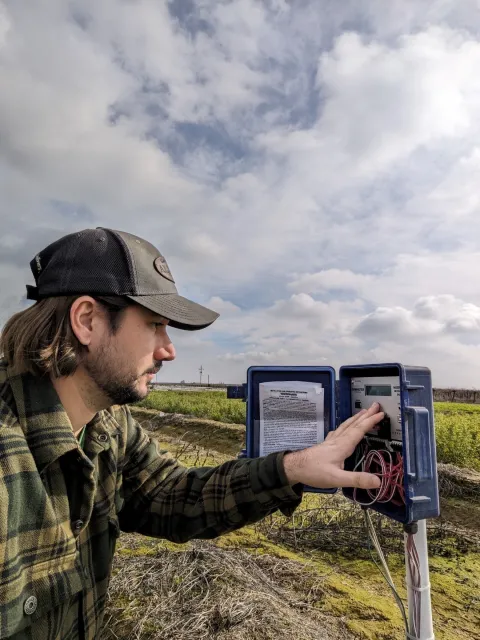
A few days later, he received a phone call from Jeffrey Dahlberg, then the director of KREC. Borg says Dahlberg told him about why Lipton funded the tea research. “What was interesting is the reason Lipton wanted to do the research was because of the closing of mainland China to Western markets, and there was a feeling that there would be a loss of tea, and Lipton needed to find other places that they could get tea from, so they were doing the research,” he says.
In 2016, Jacquelyn Gervay-Hague, professor emerita at UC Davis’ chemistry department, decided to continue the work of UC Davis professor Karl Ingebretsen, who oversaw the original Lipton studies. She and her team collected various tea plants from across California and grew clonal cuttings for planting. They planted for the first time in 2017 and expanded planting in 2018. After Gervay-Hague concluded her research that year, Atef Swelam, director of KREC and the West Side Research and Extension Center, decided to revitalize the tea project.
“When I came to Kearney, I found we had almost a half-acre, or no more than half-acre of tea,” Swelam says. “It used to be a project used by Dr. Jacquelyn Hague, and then she concluded the project. Then I said, ‘Okay, let’s take it forward.’” Gervay-Hague says the tea plants are now “at their full production capability” and will be harvested for the first time this April.
How thirsty is tea?
Tea is a high-water-input crop, which poses problems in drought-prone California. However, it is also a high-value crop, which might make it surprisingly well-suited to a drier future.
Swelam says that when the Sustainable Groundwater Management Act is fully implemented by 2042, around 1 million acres of California farmland will become non-functional due to insufficient water for cultivation. To address this issue, UC ANR researchers are seeking climate-smart solutions and crops that offer a higher value per acre than other thirsty crops like almonds, pistachios and grapes. Swelam explains if someone has one acre of land, produces 1 to 2 tons of tea and sells it for $100 to $290 per pound, they could net a profit of about $100,000 to $150,000 annually.
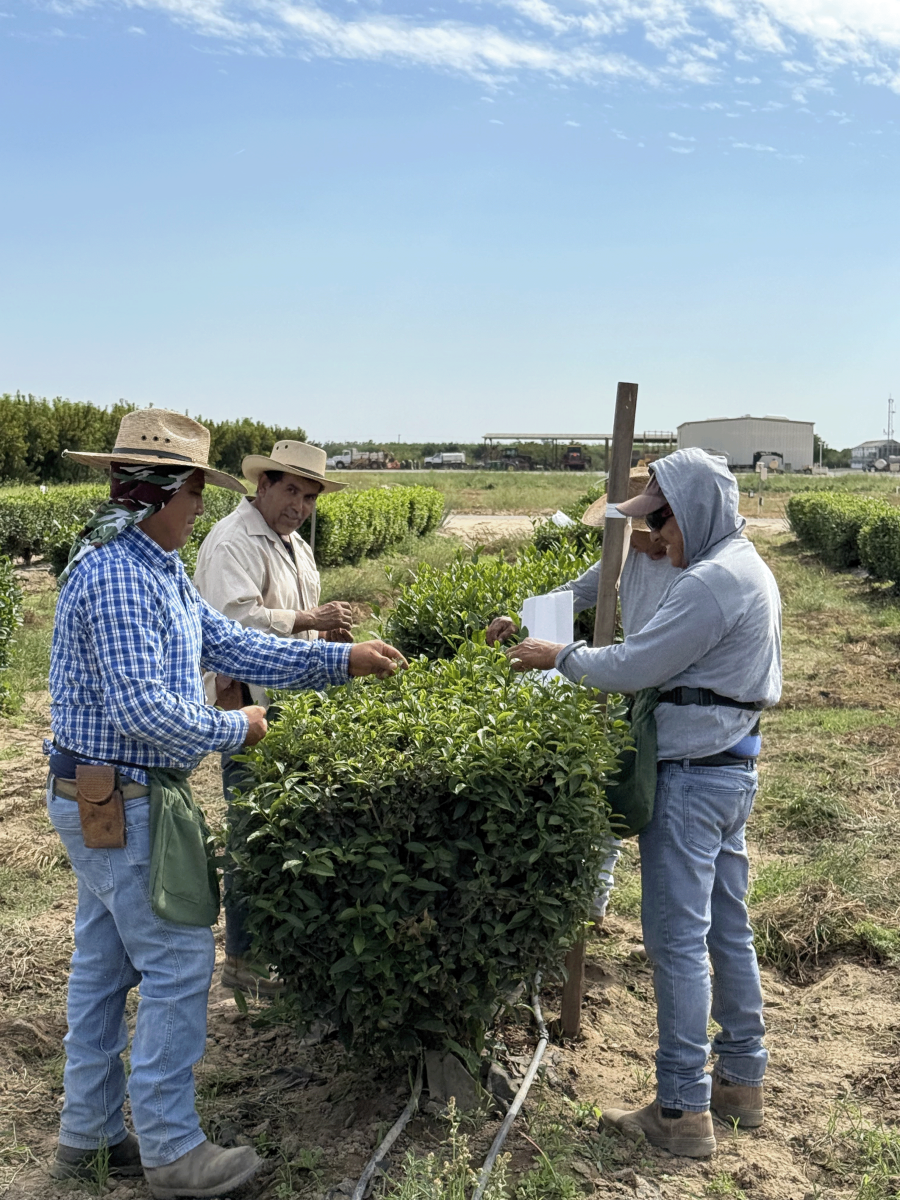
Workers tend to tea plants at the Kearney Agricultural
Research and Extension Center. (Courtesy photo)
Currently, less than 1,000 tons of tea are produced across the United States, representing less than 1 percent of national consumption, according to the Global Trade Algorithmic Intelligence Center. This means 99 percent of tea is imported, or 123,000 tons in 2024, according to the agriculture food tech platform Tridge. Swelam says if the U.S. can produce 10 to 15 percent of tea domestically, it would reduce dependence on imports and move the U.S. closer to self-sufficiency.
Swelam also says California is considered a “food basket” for the entire world. The state is the world’s largest producer of almonds,pistachios and a dominant producer of grapes in the U.S., according to the U.S. Department of Agriculture. “So California is the food basket, especially from the Central Valley, which is the most productive and biggest, largest productive area in the world,” Swelam says. “So anything you do in Central Valley, it would reflect not only in California, but for the United States, even for the entire world.”
The future of tea
Now that the tea is ready to be harvested, KREC plans to host its first CA Tea Day, inviting farmers to choose one of three top cultivars they have selected, based on research showing they perform favorably among the 21 varieties, and start generating income. Gervay-Hague has developed standard operating procedures for farmers adopting tea as a cash crop and for managing it.
The community will also have opportunities to learn how to process tea leaves and brew tea at home. In fact, tea plants make excellent ornamental plants. Tea plants of Camellia sinensis are prized for their versatility, aesthetic appeal and ability to help consumers enjoy homegrown tea. “You can have it as a landscape,” Swelam says, “and you can enjoy the landscape and enjoy and drink the tea.”
–
Follow @comstocksmag on Instagram!
Recommended For You
The Chinese Art of Tea Takes Hold in the Sacramento Region
Practitioners say gongfu cha encourages mindfulness and presence
Gongfu cha, which means making tea with effort in Chinese, is a method of preparing and appreciating high-quality tea in small amounts, through repeated pours. Many are turning to the art form as another way to find balance and harmony.

Inside California’s Small but Growing Artisanal Tea Industry
Farmers in the Sierra Nevada and Central Valley are discovering a distinct California tea terroir
Tea is the world’s second most popular beverage after water.
Though California-grown tea is currently a small industry, it may
be poised to take on some of that demand.

Is Tea the New Happy Hour?
These Capital Region tea rooms bring a California twist to an English tradition
Afternoon tea evokes something people have always sought — “a feeling of rarely experienced elegance and class,” Mueller says.
Brewed to Perfection
The most popular course at UC Davis teaches engineering students the scientific art of making coffee
Coffee is a $225 billion industry in the U.S., providing 1.6 million jobs. But are we growing, roasting and making the best cup possible? That’s what an innovative program at the UC Davis School of Chemical Engineering has been working on for the past 10 years.