


As the Sacramento Superior Court settles into the new Tani G. Cantil-Sakauye Sacramento County Courthouse at 500 G Street, the former Gordon D. Schaber Sacramento County Courthouse has entered a very different phase of public life. The six-story downtown building, roughly 470,000 square feet, is now for sale at $13.6 million, according to the California Courts Newsroom.
The listing puts one of downtown Sacramento’s larger civic properties into a market still working through elevated office vacancy, new work habits and pressure to find productive uses for public assets that no longer serve their original role.
Schaber’s next chapter may show what Sacramento can do with large civic properties once their first purpose has passed.
Randy Getz and Jim King, the real estate brokers listing the property, say the early conversations already point away from a standard office deal.
“This is not a conventional lease office,” Getz says. “This is different because it’s a structure that will likely be converted for an alternative use.”
The Gordon D. Schaber Sacramento County Courthouse was built in
1965. (Shutterstock photo)
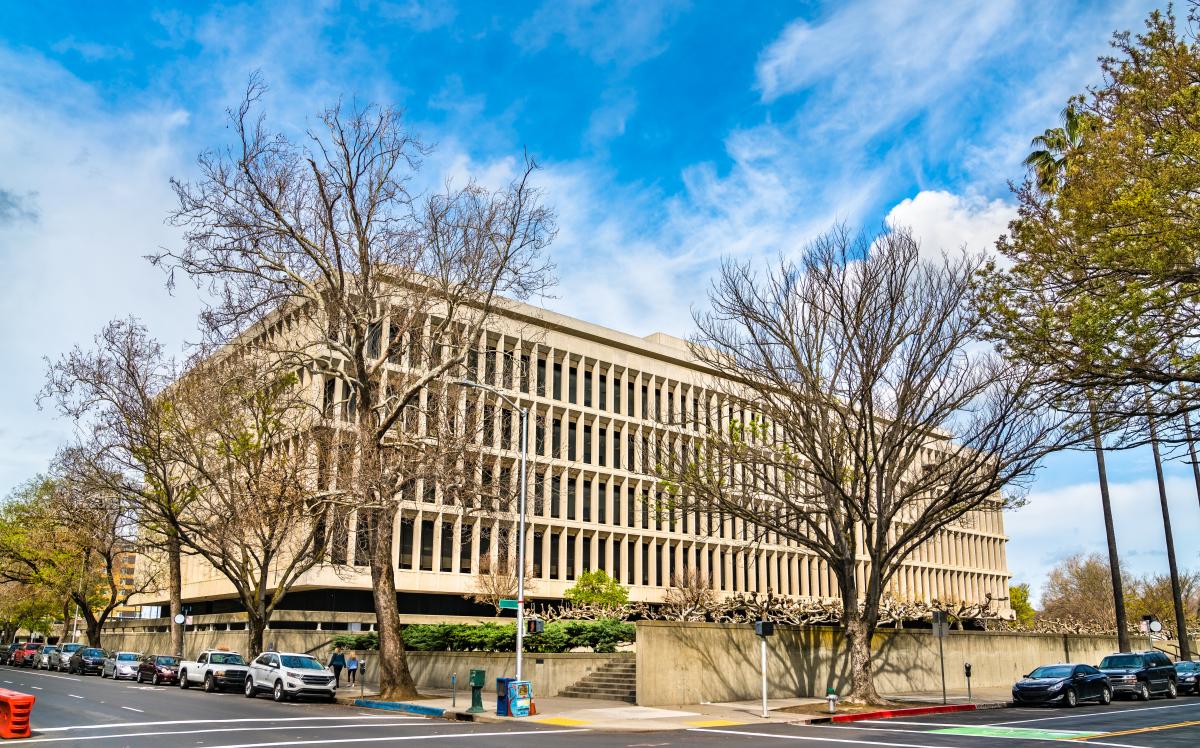
So far, they say, the people studying the property are experienced developers who seem more interested in using the building as-is than in tearing it down. The uses coming up most often are hospitality concepts, hotel use and multifamily housing.
The listing comes as Sacramento’s office market is still finding its footing after the pandemic. Colliers reported that the city’s office vacancy rate decreased 60 basis points year over year to 21.3 percent in the first quarter of 2026, with minimal occupancy losses and signs that the market has bottomed out. That context helps explain why Schaber is being discussed less as a conventional office listing and more as a redevelopment opportunity. Any buyer will have to decide what use can justify the time, cost and approvals needed to remake a full downtown block.
The sculpture outside the Gordon Schaber Courthouse was
originally a fountain called Proteus after the sea shepherd of
Greek mythology. It was designed by artist Aristides Demetrios.
(Photo by Ken Lund via Wikimedia Commons, licensed under CC BY-SA
2.0)

According to Getz, the final number will depend less on the asking price than on what the redevelopment requires. “The price is not the driver,” he says. “It will be determined by the people who have to invest the time, effort and capital.”
In redevelopment, the overall calculation depends on how long a project will take, what the desired outcome is and what it will cost once all the variables are weighed. In Getz and King’s view, the opportunity lies in the rarity of the site: a full downtown block with a substantial building already in place. They have not seen anything that would rule out reuse at this stage. “As far as we can tell right now, there are no fatal flaws with the building,” Getz says.
However, the building’s physical traits will still narrow the field. Getz and King say Schaber has an abundance of natural light, which gives developers more options than many office conversions.
Noah Kelly with Dreyfuss + Blackford says daylight is often one of the first tests in adaptive reuse. Residential projects rely heavily on natural light and views, so the deeper parts of a large floor plate, which refers to a broad building floor with interior areas set far back from windows, can quickly become harder to convert into valuable living space.
“Residential is a highly daylight-dependent program,” Kelly says. “People ultimately want natural light and views in their living spaces.”
That makes multifamily possible to consider, but not simple to execute. Areas far from windows may need to become circulation, storage or support space unless a developer makes larger interventions. For a building this size, those decisions quickly become financial decisions.
But this means that other uses may fit the courthouse more naturally. Kelly says the site’s location near City Hall and the broader judicial district could support a university tenant tied to public policy, law or civic leadership, paired with public-facing uses on the lower levels. Getz and King also see possibilities in the courtrooms themselves, where educational or medical uses could work, even though those groups have not yet shown interest.
For a property that has occupied such a visible civic role, the best outcome may be one that gives the block a new economic purpose while keeping some connection to the city around it.
“Something that can benefit the community and that can also be a productive and successful project should be the goal of just about every development,” Getz says.
The sale also touches a wider policy conversation about public land. California’s Department of Housing and Community Development describes the Surplus Land Act as a framework meant to make local public land no longer needed for government purposes available for affordable housing development. Under that process, surplus public property is first circulated for review by eligible public entities before it moves further into the market. Those entities can then determine whether the property meets a public housing or redevelopment need.
The Tani G. Cantil-Sakauye Sacramento County Courthouse opened in
April 2026 at 500 G Street. (Shutterstock photo)
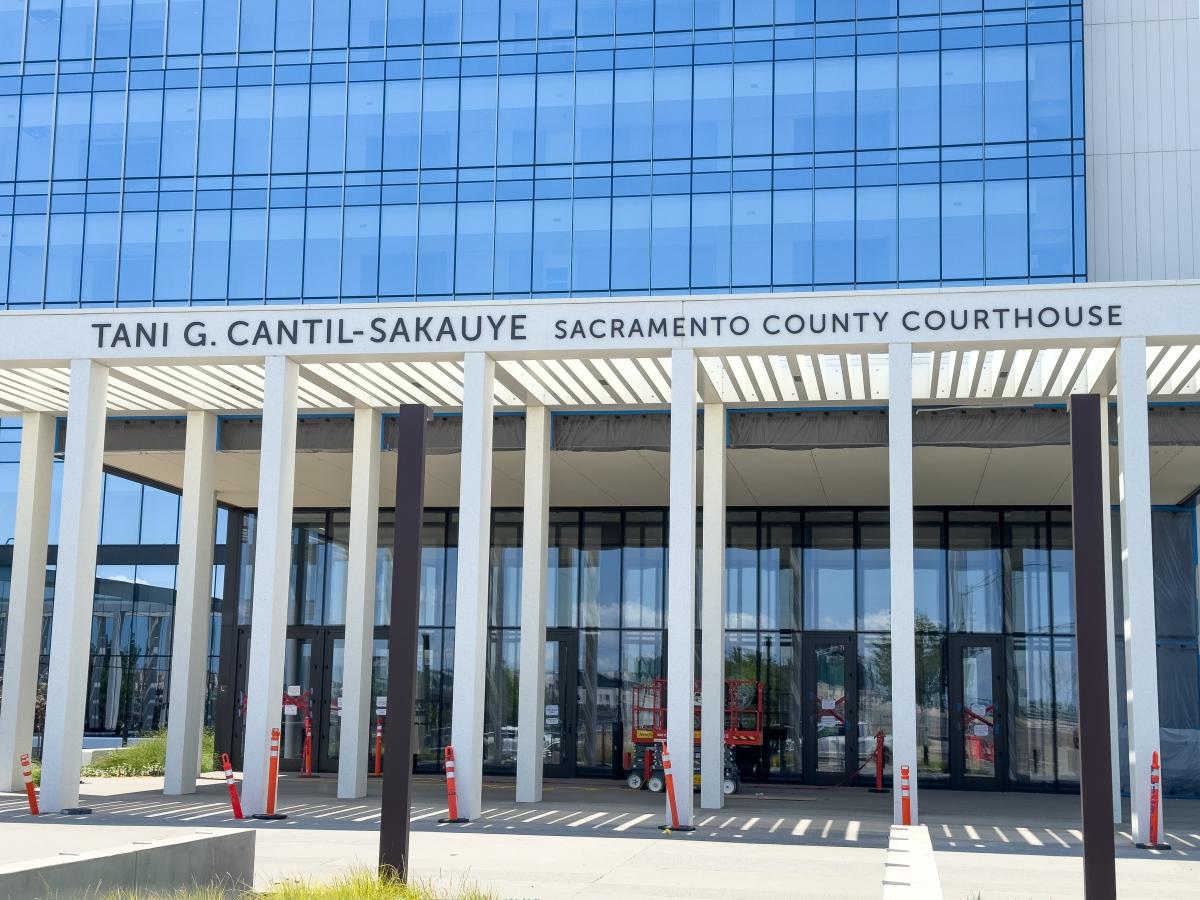
Getz says that the Judicial Council has already worked through the public-entity review process, and no eligible public entity has chosen to take on the project.
With all of this in mind, Schaber’s outcome may tell Sacramento something that goes beyond a single sale. For example, a hotel or housing project would point to private capital willing to take on comprehensive conversion work.
On the other hand, an institutional or civic reuse would suggest there is still demand for large public-facing spaces downtown. Demolition would say something else entirely, suggesting that the cost, timing, or physical limits of reuse made it more practical to clear the site than convert the existing building.
For now, the brokers say they are still introducing the property to potential buyers. “We’re in the process of acquainting people with the property and if it might work for them,” Getz says. “I think people are less concerned with what something was and what it was used for and more concerned with what it could be and what it would cost.”
–
Never miss a story: Get Comstock’s weekly newsletter delivered to your inbox.
Recommended For You
Inside 5 Stunning Northern California Homes Shaped by Their Surroundings
Architects reveal how site conditions, climate and homeowner vision influenced every design decision
In the Capital Region, where climate and landscape vary from valley floors to foothill ridgelines, responsiveness often defines the final outcome.

Can Sacramento Build Its Way Out of the Housing Crisis? Experts Weigh In
Home building experts discuss the challenges of creating new housing. A Comstock’s roundtable discussion
Comstock’s recently summoned an expert panel to discuss how partnerships between builders and local municipalities are going.
Sacramento’s New Strategy to Fight Loneliness Starts Outdoors
One in three Americans feel lonely. Sacramento is building free community spaces to bring people together
From West Sacramento to Natomas, new parks and community projects are tackling one of today’s most urgent public health challenges: isolation.
Meet the Man Behind Some of Sacramento’s Most Iconic Buildings
Getting to Know: Climbing girders and remaking Sacramento’s waterfront at 65, Steve Ayers says he’s in his prime
Steve Ayers owns or has sold dozens of buildings in Sacramento and says he’s “only just begun.”