


This story is part of our October 2026 issue. To read the print version, click here.
After months of negotiations, revisions and competing priorities, California has a $351.7 billion budget that balances the books for 2026-27. The enacted version looks considerably different from the budget California started with in January, when the state projected a $23 billion structural deficit — a gap between the ongoing revenues the state expects to collect and the ongoing costs of maintaining current services.
Stronger-than-expected revenues, changes in spending and a series of negotiations ultimately produced a plan that balances the next two fiscal years and sets aside $35.2 billion in reserves and other funds. The budget also preserves major commitments to healthcare, education and other public services, while providing roughly $251.5 billion in General Fund spending.
For the Capital Region, that is welcome news. State government remains one of the area’s most powerful economic drivers, even as the local economy works to diversify. The flip side is that Sacramento could feel the effects if California’s revenues weaken or state spending contracts.
The 2026-27 budget reduces the projected 2029-30 structural deficit to $8.3 billion, but the gap remains.
For Christopher Thornberg, founding partner at Beacon Economics, the projected deficit signals that California’s budget pressures have not gone away.
“California didn’t really balance the budget,” he says. “It’s still papering over giant holes.”
Scott Graves, budget director at the California Budget & Policy Center, sees the state’s fiscal position differently. His focus is not simply on whether California should spend less, but whether the budget’s assumptions are reasonable given the information available to policymakers.
Graves also points to a proposal delayed until 2027 that would require large corporations whose low-paid workers rely on Medi-Cal to contribute toward the cost of that coverage. He describes the so-called “fair share” approach as a potential revenue solution that would require highly profitable companies to contribute more toward the public services they rely on.
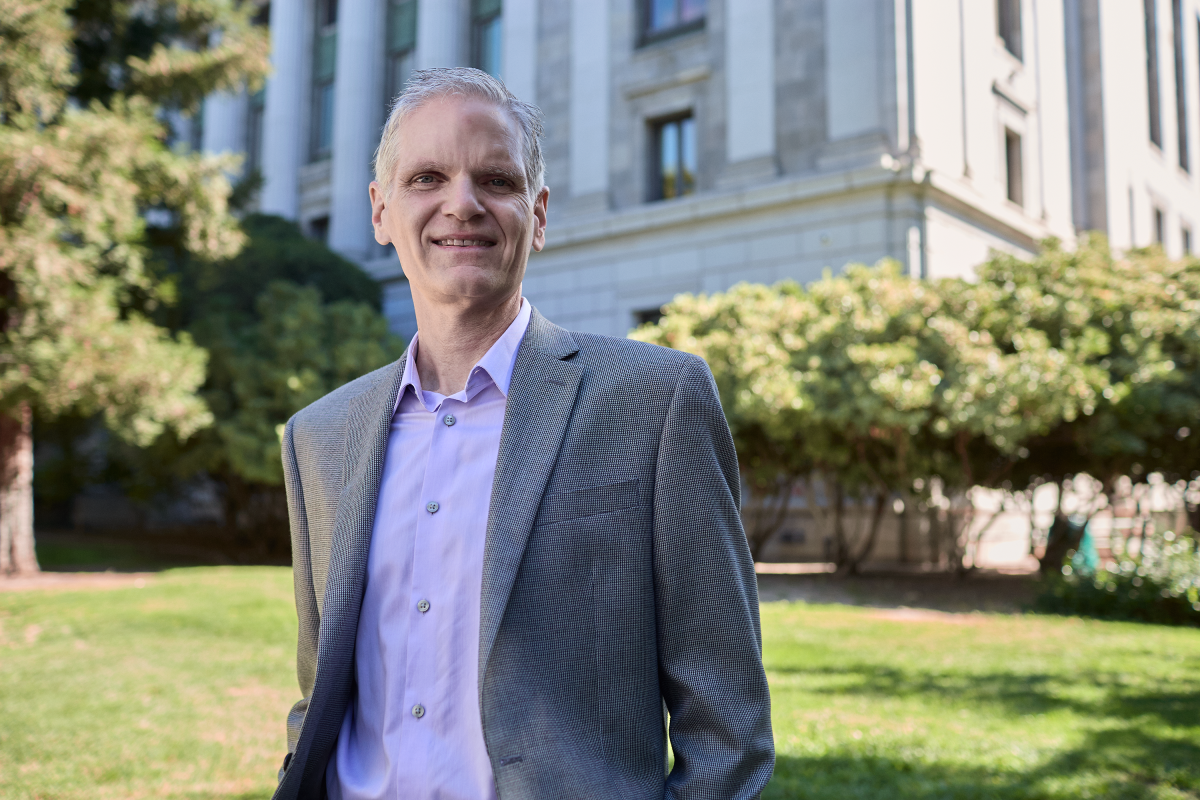
Scott Graves, budget director at the California Budget & Policy
Center, says state budgets are projections, and policymakers have
to make decisions based on the information available at the time.
(Photo by Tyrel Tesch)
Barry Broome, president and CEO of the Greater Sacramento Economic Council, takes a different view, focusing on the region’s dependence on state government and its efforts to diversify.
“The reason we work so feverishly in our organization is our level of dependency on the government for an economy is dangerously high here,” he says.
Sacramento has spent years trying to reduce that dependence. Broome points to the growth of advanced industries, including semiconductors and other technology companies, as evidence that the region is becoming something different. He says the organization’s diversification efforts have helped create 39,000 industry jobs since it was founded in 2015.
In the short term, Broome sees the budget as favorable for Sacramento, particularly because of its investment in higher education.
In the 2026-27 budget, California included $1.2 billion in new ongoing General Fund support for the University of California and California State University combined, along with additional funding for community colleges.
“At the end of the day, I think this is a good budget for Sacramento,” Broome says.
But he does not consider the state’s underlying fiscal problems resolved.
“Everything California does makes my job harder,” Broome says, arguing that California’s tax and regulatory environment makes it more difficult to create jobs and opportunity.
The budget also relies on more than $5 billion in new annual revenue, including applying sales tax to digital downloads of software, capping some business tax credits and renewing a tax on health plans, underscoring the tension between balancing the state’s books and the costs of doing business in California.
“At the end of the day, I think this is a good budget for Sacramento.” Barry Broome, president and CEO of the Greater Sacramento Economic Council
California also relies heavily on revenue tied to the performance of financial markets, leaving the state’s finances vulnerable to swings in the economy and investment markets.
The Legislative Analyst’s Office warned about that exposure. In January, the nonpartisan office said recent revenue strength was driven largely by personal income taxes and a bullish stock market, with much of the stock market appreciation coming from companies associated with artificial intelligence. The LAO cautioned that California’s revenue gains could reverse if financial markets weaken.
Thornberg contends that California’s progressive income tax structure makes state revenues particularly sensitive to swings in asset prices. When stocks and other assets rise, capital gains can generate a surge in tax collections; when markets fall, those revenues can disappear quickly.
That volatility creates a fundamental mismatch, he says. A temporary windfall can help close a temporary hole, but is much less effective at financing programs that continue year after year.
Thornberg says the current cycle is unusual because two successive forces boosted asset prices: the enormous monetary stimulus of the pandemic era, followed by the surge in artificial intelligence-related companies.
“The bubble reinflated,” he says. “So we didn’t really solve the 2021-22 problem. Instead, we just kind of got lucky.”
Budget Director Graves takes a different view of that uncertainty. He says state budgets are projections, and policymakers have to make decisions based on the information available at the time rather than assuming revenues will fall.
“There’s always going to be an element of optimism to some extent built into budgets,” Graves says. “These folks are coming to Sacramento to provide services to Californians. They’re not here to cut vital services.”
California has more than $15 billion in its main rainy day fund, along with roughly $9 billion set aside for K-12 schools and community colleges. Those reserves do not eliminate the state’s exposure to revenue declines, but they give policymakers more options when revenues fall, says Graves.
The budget also illustrates the trade-off between balancing the books today and meeting longer-term commitments: The state is withholding $3.9 billion owed to schools under Proposition 98 for 2025-26, with repayment tied to future revenues.
Suzanne O’Keefe, professor of economics at Sacramento State, says
spending increased during the pandemic because federal grants
were available. Now those funds are gone, but the programs they
funded remain. (Photo by Tyrel Tesch)

The LAO has documented the broader increase in state spending, finding that general fund spending rose by more than $100 billion between 2019-20, and the governor’s proposed 2026-27 budget rose from $146 billion to $248 billion. The enacted budget later increased General Fund spending to about $251.5 billion.
Suzanne O’Keefe, professor of economics at Sacramento State, says much of that increase in state spending began as one-time pandemic spending supported by federal grants, but some of those programs have since become entrenched in the ongoing budget. She puts the increase in a broader context: Overall inflation was about 30 percent between 2019 and 2026, while General Fund spending increased nearly 70 percent.
“I think the new budget postpones making hard decisions,” she says.
Her concern is what happens when spending commitments remain after extraordinary revenues or federal assistance that helped support them have disappeared. In her view, if revenues rise, California tends to expand spending; when revenues fall, policymakers are reluctant to shrink those commitments.
Thornberg of Beacon Economics describes the budget as “kicking the can down the road,” arguing that California has repeatedly postponed difficult decisions when rising asset prices have produced unexpected revenue.
“At some point in time, we’re going to have to pay the piper, and there is going to be a difficult contraction in state spending.”
He maintains that the fundamental problem is not simply whether California can generate enough revenue, but whether the state can sustain its current level of spending when unusually strong revenue growth fades.
“The state has really accelerated its spending,” he says. “So, most folks would argue this is a spending problem, not a revenue problem.”
At the same time, Graves cautions against assuming that a downturn is inevitable. Cutting services prematurely, he says, could harm Californians based on a problem that may not materialize.
That uncertainty puts a premium on Sacramento’s ability to grow sectors that are less dependent on state government.
Professor O’Keefe says the employment mix itself suggests the region is becoming more diversified. State labor market data show the Sacramento metropolitan area added nearly 10,000 private-sector jobs over the year ending in June 2026, even as federal and state government employment declined.
Broome says that growth is coming from sectors that include healthcare, advanced manufacturing and technology, providing Sacramento with economic activity beyond state government.
Thornberg sees that diversification as an important distinction for Sacramento. The region has an advantage that some other California regions lack — an actual supply of new housing. He contrasts that with the Bay Area, where a lack of housing has stymied growth.
“Sacramento is an area that gets a lot of its economic support from the state budget. There is no real mystery there,” Thornberg says. “That said, it’s not the only part of the local economy. It’s worth noting that Sacramento has actually been one of the fastest-growing parts of the economy over the last seven years.”
Robert Heidt, president and CEO of the Sacramento Metro Chamber of Commerce, says the budget provides some near-term stability but does not resolve the state’s broader competitiveness issues. For businesses, he says, housing, healthcare, infrastructure and workforce development remain priorities, along with broader concerns about energy, regulations and the cost of doing business.
“The more certainty that we have at any juncture brings peace of mind so that business owners can really focus on hiring, expansion and investment,” he says.
“The harder task is building a fiscal structure and an economy that can stay balanced when the good times end.”Christopher Thornberg, founding partner, Beacon Economics
For Graves, the next governor will have some time to assess the state’s fiscal position before making the biggest policy choices. The January 2027 budget will largely be prepared by the Department of Finance, while the May revision will give the new governor the first major opportunity to put a personal imprint on the state’s fiscal priorities.
The new governor will also inherit some difficult policy decisions. Much of the budget’s most significant Medi-Cal reductions, including a lower asset limit and changes to some benefits and payments, are scheduled for July 2027, months after Gov. Gavin Newsom leaves office, leaving some of the hardest choices for the next administration.
The state’s current budget assumes that revenues and spending will track reasonably well through the next two fiscal years. Graves says policymakers acknowledge the projected $8.3 billion structural deficit in 2029-30, but he emphasizes that the figure is a forecast, not a certainty.
Thornberg says California remains vulnerable to a substantial deficit if the stock market returns to something closer to historical norms. Because California relies heavily on income taxes paid by high earners, a sharp decline in stock prices can quickly translate into lower tax collections when capital gains disappear.
“The stock market bubble has reemerged,” he says.
For Sacramento, that makes economic diversification an important consideration as the state’s fiscal outlook evolves. The region cannot control California’s fiscal challenges or regulatory policies, Broome says, but it can continue developing industries that are less dependent on state government.
“We actually could be the shining star of California,” he says.
For Thornberg, however, the state’s fiscal outlook remains the larger concern. He sees the current budget as a reprieve, not necessarily a resolution.
“California has balanced its budget for now,” he says. “The harder task is building a fiscal structure and an economy that can stay balanced when the good times end.”
–
Stay up to date on business in the Capital Region: Subscribe to the Comstock’s newsletter today.
Recommended For You

How the California Government Escheated Its Way to $13 Billion of People’s Money
Looking into the loopholes of California's unclaimed property law
The state’s unclaimed property law is supposed to reunite abandoned assets with their owners. But another aim has long since taken over, say experts and attorneys for victims.

How New Capital Region CEOs See the Future
We talked to 11 of the region's new CEOs. Here are their visions
Here’s what a new crop of local leaders told us about the
future of their organizations and how they aim to advance the
region’s greater good.

California Needs a Better Way to Pay for Water Infrastructure | Opinion
The new executive director of the California Farm Water Coalition shares thoughts on infrastructure funding models
Decades of growth are still being supported by water delivery
systems built for half the population. California needs more
water storage capacity but has not provided a clear or reliable
funding source to put plans into action.

Trump’s Tariffs Hurt Some Local Businesses, but Prompt Others to Shift Gears
What impact are tariffs having on the economy of California's Capital Region?
Conversations with Sacramento-area business owners show tariffs aren’t affecting all companies the same way. At least one is expanding fast because of them. But almost everyone is seeing some effect.