


This story is part of our April 2026 issue. To read the print version, click here.
I used to be a voracious reader. When a new “Harry Potter” book was released, I’d dress up as a witch and wait in line outside Barnes & Noble until the stroke of midnight, then devour it in a few sleepless hours.
Reading was both a private joy and a skill for which I was rewarded. It won me high marks in English and praise from adults. Doors opened as a result. My reading and writing scores countered my mediocre math on the SAT, and I have these proclivities to thank for my job as an editor. Reading often and at a high level is considered a prerequisite for success in this field, and it’s assumed that we read not only for work but for pleasure.
“Avid book reader” was an important part of my identity.
Except I recently realized that I was no longer much of a reader. In fact, the number of books I’d finished since college and the years since graduation were roughly the same number.
In this shameful epiphany, I peered into the void between who I thought I was and what I was actually doing. I thought I was a person who read for fun, but in reality, I was consuming other kinds of entertainment — TV, movies and short-form videos — which felt like eating potato chips in lieu of a steak dinner. In truth, it was the idea of reading that sustained me — the act of going to the library and checking out a musty tome to display on my coffee table, only to return it after wistfully sniffing its pages. I’d been performing a role for an audience of one, myself, who wouldn’t accept reality.
Buddhists have the doctrine of anatta, or “no-self,” which defines identity as a transient and fluid experience. Clinging to self-image as an immutable truth causes suffering, while loosening our grip can allow for beneficial changes.
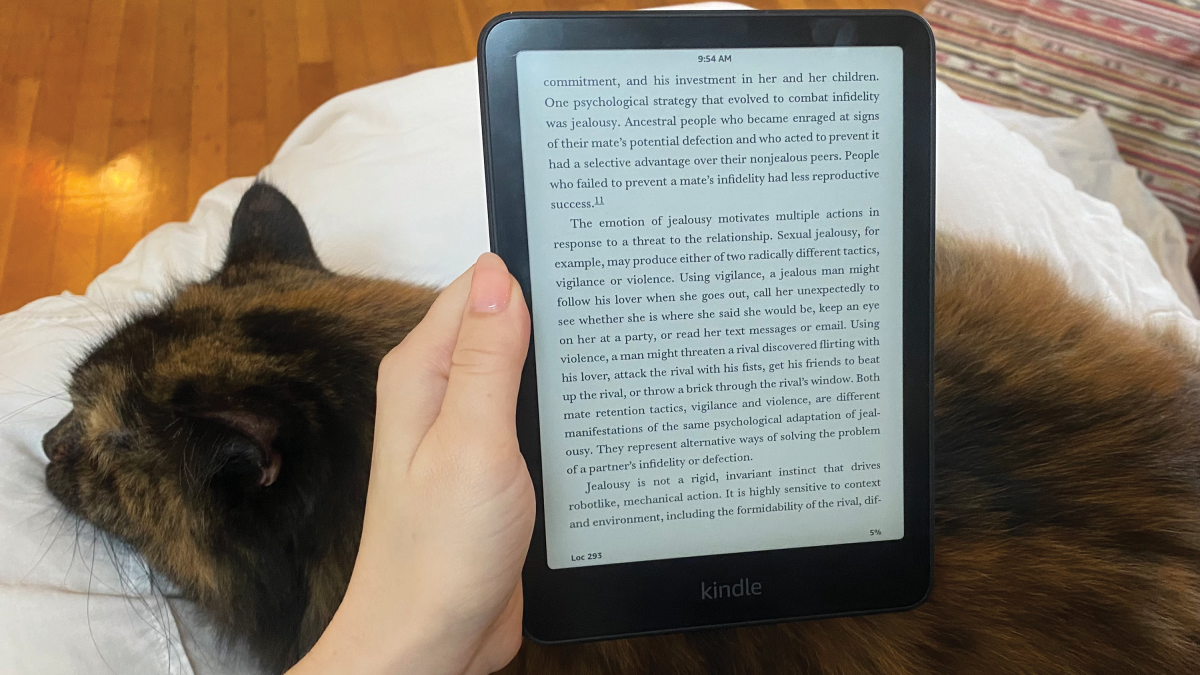
For me, that change came with a Kindle. My late grandmother, a Mensa cardholder who read more than anyone I know, had one. We were a two-member book club: She’d ask me what I was reading one weekend — usually some YA novel — and finish it before the next.
Still, as literary Luddites do, I long resisted the idea of going digital. It made me anxious, like starting a medication I feared would work too well. Books are timeless, and I like timeless things. I like the continuity of regifting a book that moved me, knowing this object transfigured by scribblings and greasy fingers may outlast my own days on earth.
The Kindle doesn’t collect that sacred grime, but it is elegant. Converts say you won’t even miss the tactile pages or the satisfaction of reading cover to cover. And while I do miss those things, my Kindle provides the means, motivation and opportunity to enjoy reading again. On-demand access to library books via Libby lets me sample stories without having to commit. The backlit screen allows me to read in the dark as my husband sleeps, which is when I’m most willing to lend my undivided attention. I’m never forced to abandon a book because I’m busy or traveling — the ample availability of titles and instant renewals lets me read in my own time, and even titles that have been returned are bookmarked so I can pick up where I left off. Because of these features, I’ve finished more books in the last three months than in all of 2025.
That said, there are some limitations to reading books on an electronic device, though water isn’t one of them. My Kindle can join me in the bath, but its tendency to steam up dampens the illusion of its Paperwhite pages. The light-reflecting technology designed to mimic paper isn’t fooling anyone at my local bathhouse, where, after getting caught sneaking mine in, I argued that e-readers should be exempt from the no-screens policy. The attendant told me to sign the petition.
In an era of “BookTok” and the elevation of aesthetics over substance, e-readers are the antithesis of performative literary consumption. Maybe this is why there’s a kinship among Kindle owners. I wish I’d joined the club when my grandmother was still alive so we could share e-books and geek out over customizable fonts and resources like Project Gutenberg, which provides free downloads of all the classics.
When she died, we inherited her collection of obsolete e-readers. Now that I have my own, I plan to fire up her latest model and see what I can find. I hope it has a trove of books and a galaxy of annotations to transfer onto mine. I hope I find her.
–
Stay up to date on business in the Capital Region: Subscribe to the Comstock’s newsletter today.
Recommended For You
Women Built History — and Still Hold It Together Every Day
For the Last Word essay, Editor Judy Farah celebrates the often-overlooked accomplishments of women of the past and present
To close out Women’s History Month, Editor Judy Farah reflects on both women’s historic accomplishments and the daily labor that keeps life going.
I Delivered 50 Newspapers a Day in Elementary School. Here’s What’s Changed.
For the Last Word essay column, a journalist reflects on how the news industry has changed since his first job as a paper boy
An unexpected visit from a delivery driver brings back memories of a childhood paper route — and raises questions about what’s left of the local newspaper.
The Big Commitment: On Friendships, Aging and the Sacred Silliness
For our Last Word essay column, Comstock's former associate editor reflects on friendship
Following an uncomfortable pause after the officiant asked if
anyone knew a reason why these two shouldn’t be joined in
matrimony, Monty, a comedian, stood up and loudly objected. Once
the giggling started, the entire crowd realized we were in for
another performance.
Essay: An Empty Nester’s Melancholy Travels Without His Children
For the Last Word essay column, a writer shares his recent travels through Europe without his children
I could, I felt, either wallow in sadness at this state of affairs or, with my wife, chart our own course and go to places that we had never previously visited, using the strangeness of new locales to ask myself a series of questions on, broadly speaking, what it all meant.
The Capital Region C-Suite: Comstock’s New Leadership Showcase Is Open for Nominations
Comstock’s magazine highlights Sacramento area influencers who lead with instinct
At a time when business is being
redefined, some of the Capital Region’s most effective executives
are leading with instinct, balance and an innate ability to sniff
out opportunities.