


This story is part of our May 2026 issue. To read the print version, click here.
“Obsession.” That’s a word I heard a lot at the Alfred Hitchcock Festival in March. It seemed the only term one writer could use to describe his 20-year compulsion to understand a menacing magnetism that somehow emanates from films released half a century ago.
He wasn’t alone. Others shared that mania at the Hitchcock gathering in Scotts Valley, including one author who’d traveled across the Atlantic Ocean just to speak with fellow fanatics about “the Master of Suspense.”
Encountering these strangers in the Santa Cruz Mountains, I felt an unsettling sense that they were doppelgangers from distant lands — mirrored doubles of myself drawn to pay homage to a storyteller who unveiled the depths of brooding fixation. After all, that theme is core to Hitchcock’s most haunting films.
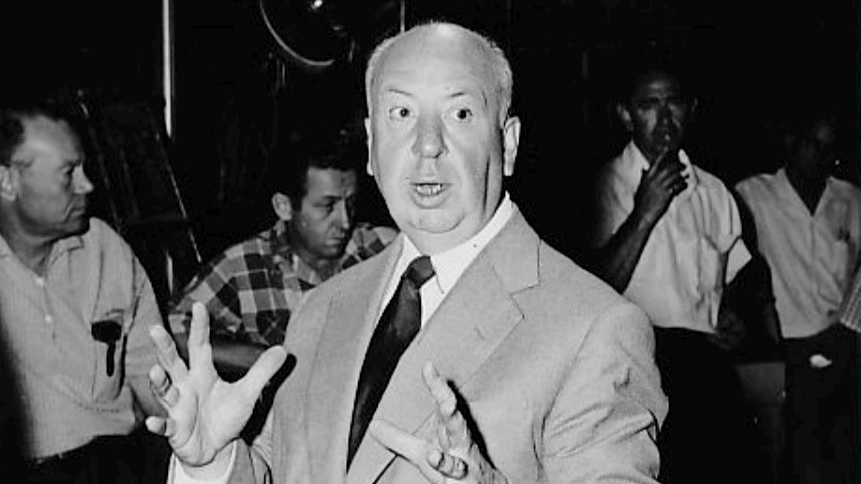
Alfred Hitchcock on the set of his television program, “Alfred
Hitchcock Presents,” in 1955. (Public domain image via Wikimedia
Commons)
Whether it’s a young woman thinking about a psychic bond with her malevolent uncle in “Shadow of a Doubt” or a detective determined to project a dead woman’s aura onto an unsuspecting saleswoman in “Vertigo” or a lonely motel clerk crushed by the weight of his domineering mother in “Psycho,” the tales Hitchcock brought to life were often testaments to the secretive and suffocating recesses we fear in our own thought worlds.
And a handful also amount to a geographic inheritance for Californians.
“Shadow of a Doubt” was filmed and set in Santa Rosa. “Vertigo” was shot around the gloomy elegance of mid-century San Francisco. “Psycho” is a story that hinges on the isolation of Central Valley towns like Tulare. These projects — along with a vivid rendering of Bodega Bay in “The Birds” — have immortalized the Golden State in glowing ways on celluloid.
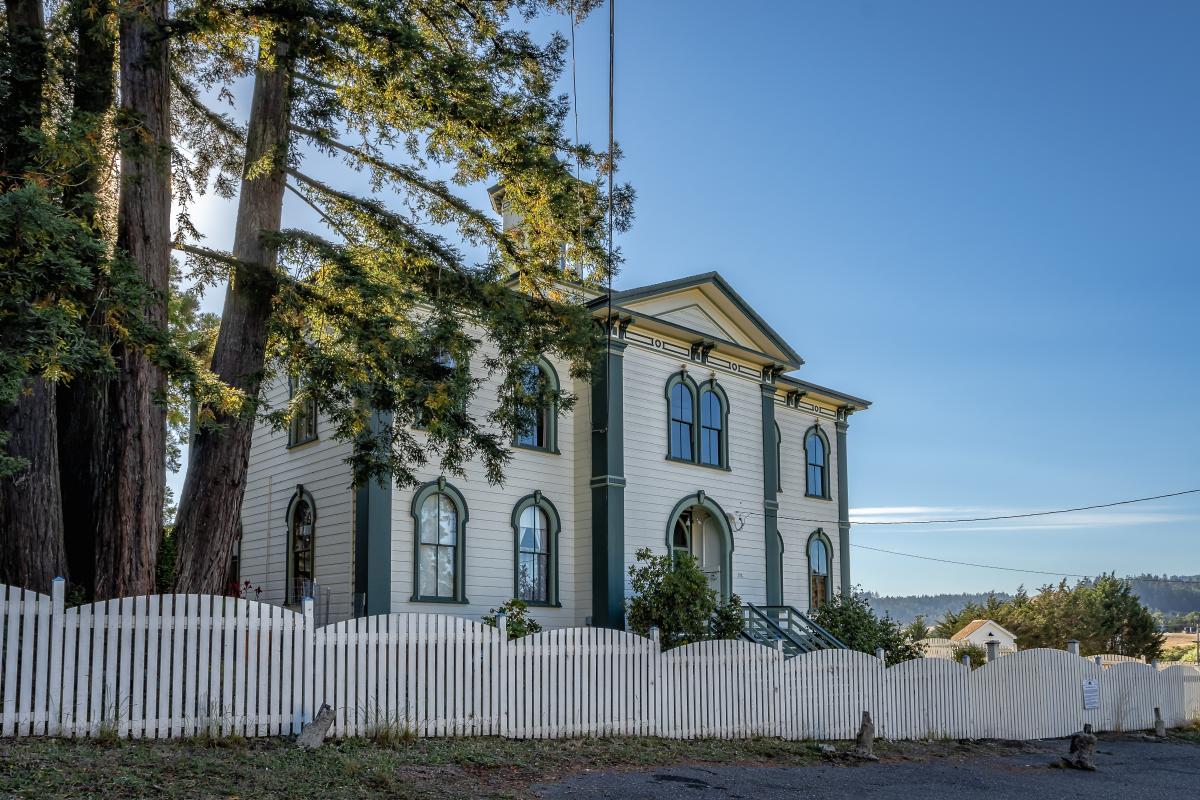
The historic schoolhouse in Bodega Bay was featured in the
Hitchcock film “The Birds.” (Shutterstock photo)
California’s life on film was, in fact, why the Hitchcock festival was being held in a tree-lined enclave 12 miles east of the Beach Boardwalk rather than the director’s hometown of London. For decades, Scotts Valley was Hitchcock’s summer home away from Hollywood. In 2022, long after the icon’s passing, Scotts Valley conceived the Hitchcock Festival as a way to raise money for a local theater group. I had arrived at its fourth go-around, which was called “100 Years of Hitchcock” because 2026 marks the 100th anniversary of his first silent film, “The Pleasure Garden.”
A key speaker there to commemorate this milestone was Tere Carrubba, Hitchcock’s granddaughter.
“I remember him being the happiest when he was here in Scotts Valley,” Carrubba recalled while sharing photos of her family with Grace Kelly, Hollywood actress and former princess of Monaco, at a mountainside ranch just up the road.
Nostalgia and film appreciation was the hook for some attendees, but I was connecting more with people like Rich Karat, a writer who had traveled to every locale around the world where Hitchcock set a scene in one of his movies. Karat is currently finishing a book on his treks.
Posters on display at the Alfred Hitchcock Festival. (Photo by
Scott Thomas Anderson)
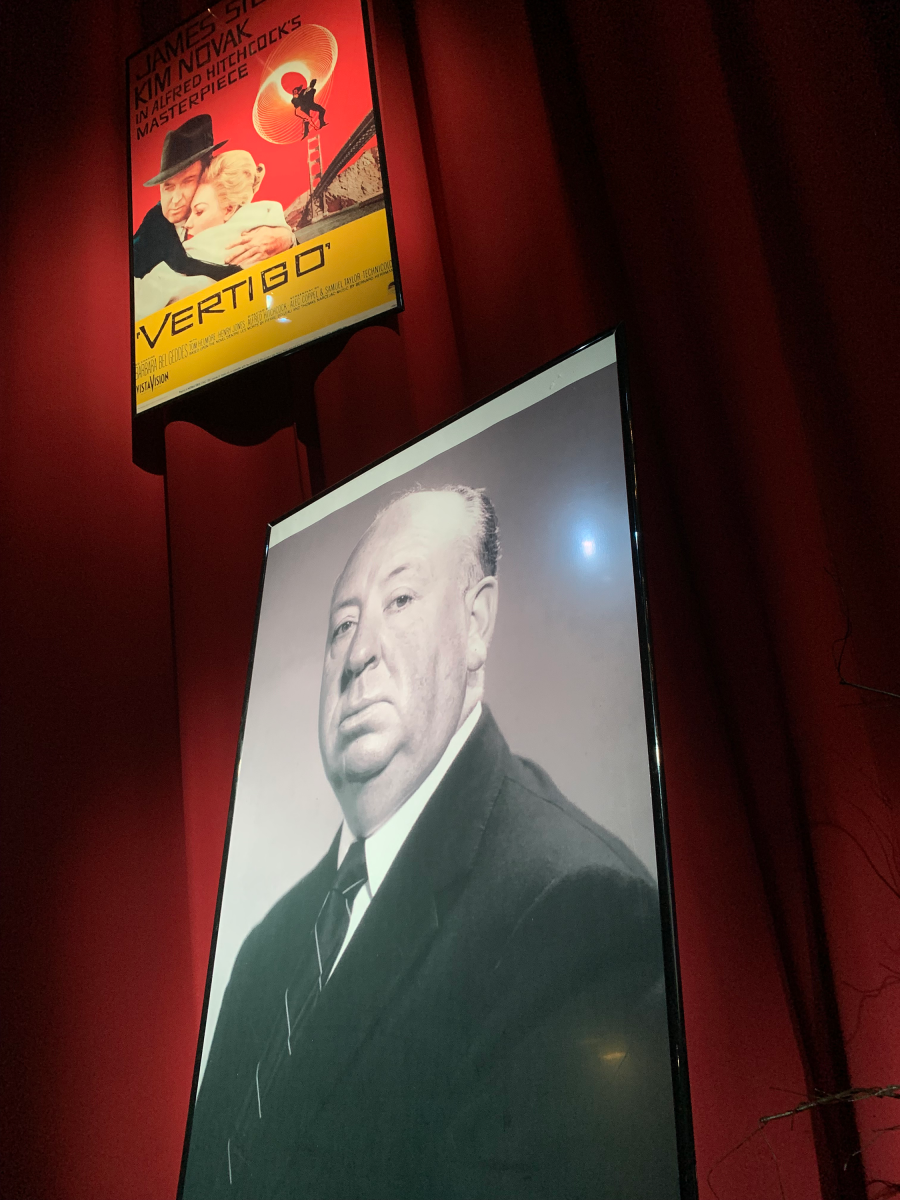
Like me, Karat was first pulled down the Hitchcock rabbit hole by the suave, unsettling shadow plays of “Vertigo.”
“I was watching ‘Vertigo’ when I was first inspired to do all the traveling,” Karat said. “I was living in San Francisco at the time, and I was hooked. I literally could step outside my door and see every location.”
I also spoke with British writer and TV producer Tony Lee Moral, who’s getting ready to release a new nonfiction book called “A Century of Hitchcock.”
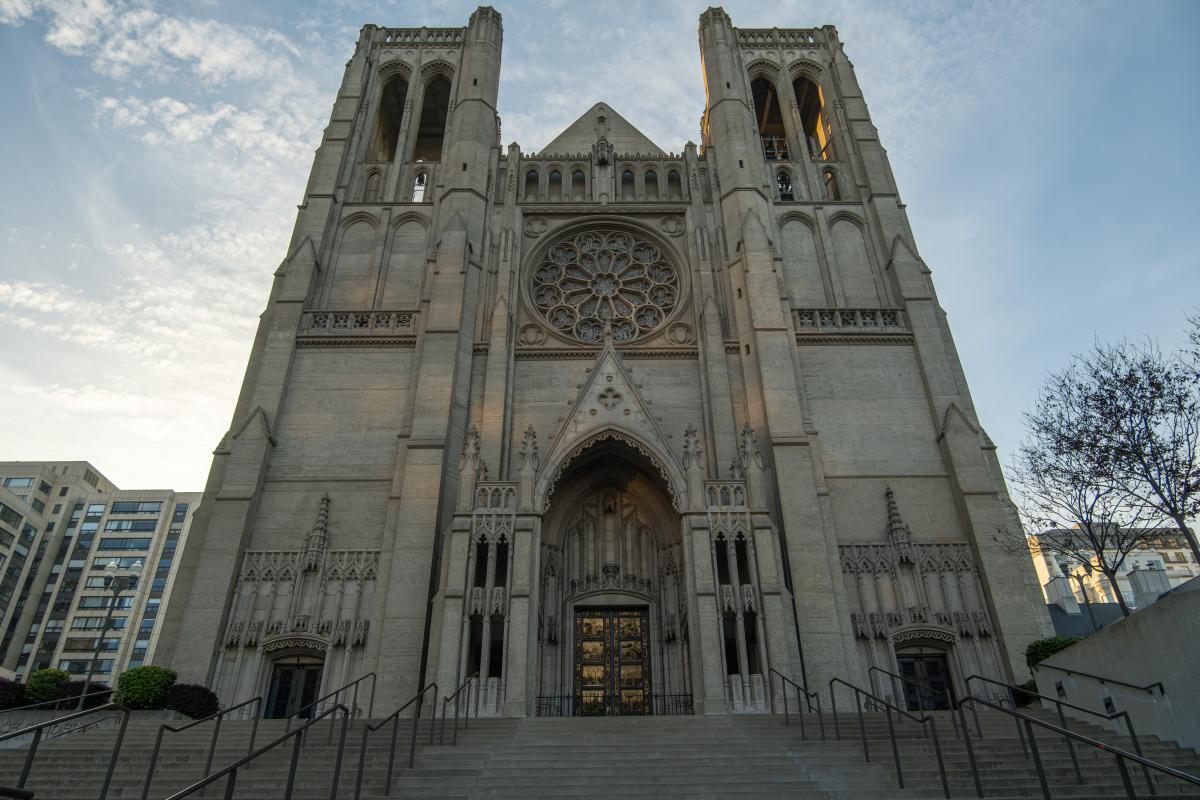
“I think Northern California is very important to understanding Hitchcock because it features in some of his very best films,” Moral pointed out. “His last film, ‘Family Plot,’ was partly filmed in San Francisco at Grace Cathedral. He loved San Francisco — it was an American Paris to him.”
San Francisco’s Grace Cathedral features in Hitchcock’s final
film, “Family Plot.” (Shutterstock photo)
I could see why Karat and Moral were at the festival, but why had I taken time out of my busiest working month of the year to spend a weekend among the redwoods and Doug-firs and 80 strangers I had nothing in common with other than one long-dead director? The answer, I eventually realized while driving along the Pacific Coast Highway, is because keeping Hitchcock’s artistic techniques and commitments alive — or just remembered — is more crucial than ever.
The last 12 months have seen a deluge of lazy, inane AI slop spilling across our aesthetic landscape, as if out of a sewage pipe of mediocrity. The entire purpose of craft could be lost under this putrid tidal wave.
The “Hitchcock touch” was about cerebral frame focus, understanding how light and shadow invoke expressionism and developing an orchestra conductor’s sense of the ways sound and music impact our soul. Hitchcock brought all these forces to bear on tense faces in the projector light. If we were to forget what he did, and how he did it, that would be — well, for the birds.
–
Stay up to date on business in the Capital Region: Subscribe to the Comstock’s newsletter today.
Recommended For You
Why I Stopped Reading Books — and How I Finally Started Again
For the Last Word column, a former 'voracious reader' shares what it took to get back in the habit
“Avid book reader” was an important part of my identity. Except I recently realized that I was no longer much of a reader. In fact, the number of books I’d finished since college and the years since graduation were roughly the same number.
Women Built History — and Still Hold It Together Every Day
For the Last Word essay, Editor Judy Farah celebrates the often-overlooked accomplishments of women of the past and present
To close out Women’s History Month, Editor Judy Farah reflects on both women’s historic accomplishments and the daily labor that keeps life going.
I Delivered 50 Newspapers a Day in Elementary School. Here’s What’s Changed.
For the Last Word essay column, a journalist reflects on how the news industry has changed since his first job as a paper boy
An unexpected visit from a delivery driver brings back memories of a childhood paper route — and raises questions about what’s left of the local newspaper.
Essay: An Empty Nester’s Melancholy Travels Without His Children
For the Last Word essay column, a writer shares his recent travels through Europe without his children
I could, I felt, either wallow in sadness at this state of affairs or, with my wife, chart our own course and go to places that we had never previously visited, using the strangeness of new locales to ask myself a series of questions on, broadly speaking, what it all meant.