


This story is part of our December 2025 issue. To read the print version, click here.
Steven Tincher’s body stiffens when he sits for too long. He may need assistance standing and securing his mobile phone in a pocket of his cargo pants. He may need help with the twist-top on the small metal vial containing the medication he takes every two and a half hours.
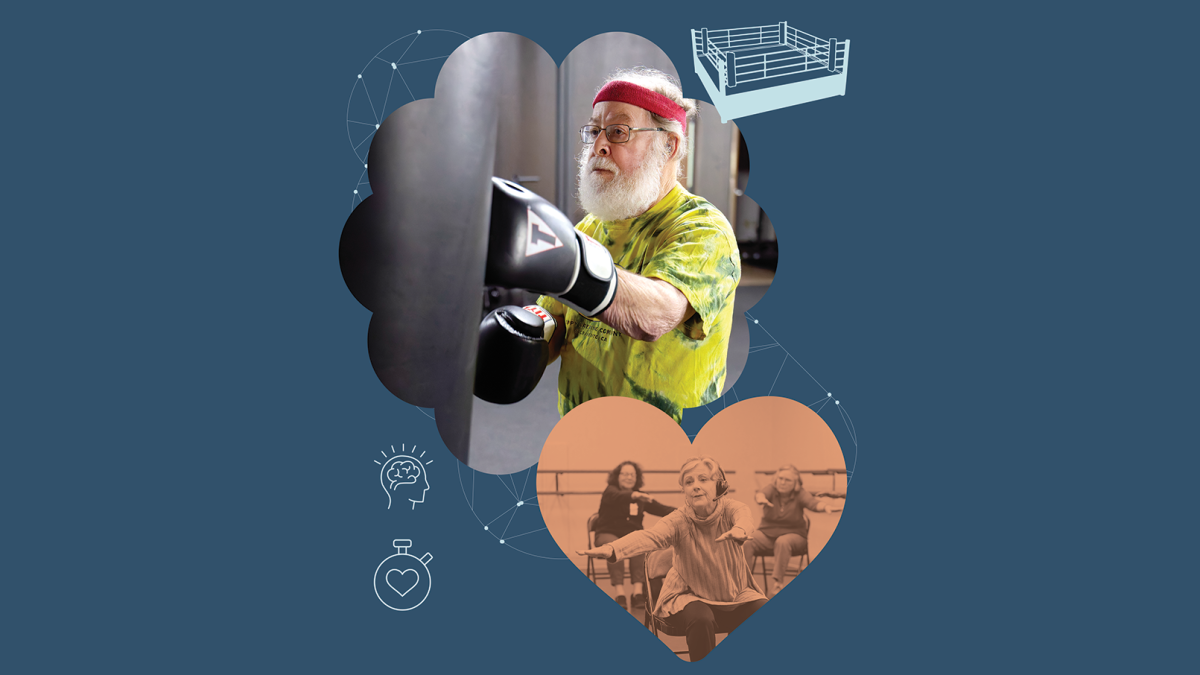
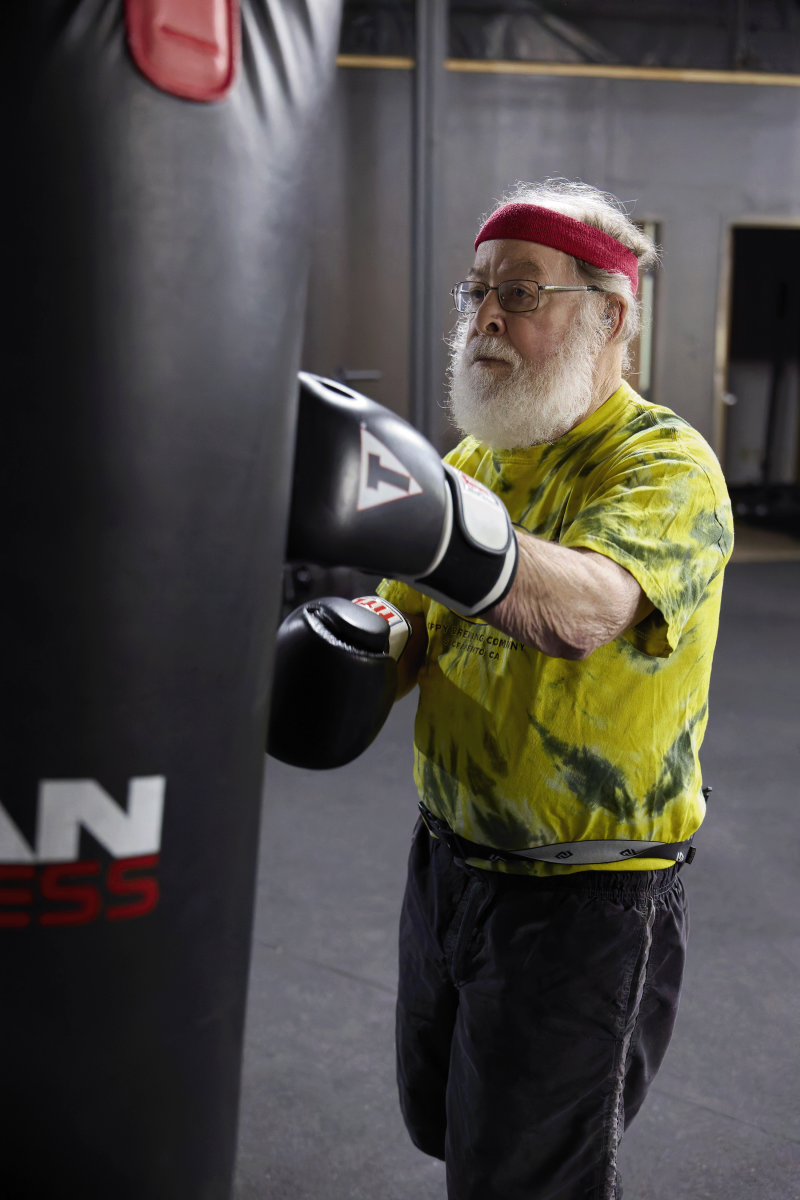
But relief can occur quickly. Like a boxer warming up while entering a ring for a match, when Tincher rises, he periodically unleashes a few quick air thrusts, sometimes with one arm, sometimes both. A retired financial analyst and computer systems integrator, Tincher is a three-year participant in the Rock Steady Boxing program in West Sacramento. He doesn’t have athletic career aspirations, but the 74-year-old Sacramentan studied martial arts for many years.
He was also diagnosed with Parkinson’s disease five years ago.
“I go into what’s called an ‘off’ stage; it’s tightness all over,” says Tincher, whose rapid-fire repeats are kung fu-oriented movements. “My hands curl, the tremors start up. I try to loosen that up. My limbs become stiffer; my whole body becomes stiffer. I am just trying anything to break that loose. Sometimes, it works; sometimes it doesn’t.”
The Rock Steady program is among the region’s more than 40 Parkinson’s disease care resource programs, including several additional international exercise organizations, such as Dance for Parkinson’s. It’s also one component of the Sacramento region’s reputation as a national hub for medical, mental, social and technological innovation to combat Parkinson’s disease.
In the competitive health care business environment, the Capital Region’s major organizations — Dignity Health, Kaiser Permanente, Sutter Health, UC Davis Health and Veterans Affairs health care — collaborate with the Parkinson Association of Northern California, or PANC. The objective is to increase awareness in the medical and public communities.
The rising prevalence of Parkinson’s
Established in 1996 and headquartered in Folsom, PANC is among the country’s most prominent independent organizations focused on movement disorders. It includes physicians, physical therapists, speech pathologists, social workers and other providers.
It started about the same time Dr. Suketu Khandhar, a neurologist and the longtime medical director of Kaiser Permanente’s Comprehensive Movement Disorders Program, orchestrated a meeting at an international conference with Dr. Norika Malhado-Chang of UC Davis and Dr. Nicklesh Thakur, an osteopathic specialist with Sutter Health. Movement disorder specialists were few.
Steven Tincher, a retired financial analyst and computer systems
integrator, has participated in the Rock Steady boxing program in
West Sacramento the past three years. The movement helps with his
Parkinson’s. (Photo by Fred Greaves)
“It was to learn from each other and to be able to discuss new treatments and technologies, and then to be able to have representation from the Parkinson Foundation present to witness the conversation and be part of the dialogue.”
Malhado-Chang and Dr. Lin Zhang, also a neurologist, now co-direct the UC Davis Health Parkinson’s Foundation Center of Excellence.
It opened in Midtown Sacramento in January 2024 as the region’s first Parkinson’s disease multidisciplinary clinic. The group from the five health care systems calls its quarterly meetings Journal Club. With PANC representation, the collective examines the increasing prevalence of the disease.
“We talk about new treatments, and we invite the industry to come and kind of share if there is something new, if they are a sponsor,” says Khandhar. “It’s really been (that way) for the past 15-plus years. It gives us an opportunity to grow together. It’s given us an opportunity to share. It’s allowed us to convey to our constituents, whether it’s PANC or our own patients.”
Related: Move Your Body: New approaches to physical therapy take a swing at Parkinson’s disease
More than 1 million people in the United States and an estimated 10 million globally have Parkinson’s disease, according to Harvard Medical School. Some experts believe the number will double by 2040.
That predicted statistic is difficult to quantify, says Khandhar, but he believes there are three reasons for increased diagnoses: an aging population, exposure to toxic substances in our environment and more knowledge among non-neurologist physicians who recognize Parkinson’s symptoms.
“Many of us believe that Parkinson’s can be triggered by exposure to harsh chemicals in our environment, maybe the water you drink, maybe certain kinds of pesticides and herbicides used in our farming industry or on our military bases,” says Khandhar. “Unfortunately, we are reliant on some of these things. And yet this stuff seeps into our water, it seeps into our food, and it may generate some sort of opportunity to breed the condition.”
California’s vast Central Valley agricultural industry has the dubious nickname “Parkinson’s Alley.” A 2011 UCLA study found that Central Valley residents under the age of 60 who lived near fields where the pesticides paraquat and maneb were used between 1974 and 1999 had a Parkinson’s rate five times higher than other residents in the area.
Boxer and activist Muhammad Ali, who died in 2016, and actor Michael J. Fox, who was diagnosed in 1991, publicly battled Parkinson’s and both established foundations to support research and awareness. The icons’ work put the disease in public focus.
The Michael J. Fox Foundation for Parkinson’s Research, which the actor founded in 2000, has lobbied for a ban on agricultural pesticides. The actor’s prominence and willingness to share his personal life, including in the 2023 Netflix documentary “Still: A Michael J. Fox Movie,” have generated increased public awareness.
James Parkinson, for whom the disease is named, described its symptoms in 1817 as “involuntary tremulous motion, with lessened muscular power, in parts not in action and even when supported.”
Related: When the Sun Sets on the Golden Years: The hardship and high cost of caring for a loved one in decline
A modernized definition details Parkinson’s disease as a neurodegenerative disorder that causes a decline in motor skills, balance, speech and sensory functions, eventually affecting the autonomic nervous system.
For Steven Tincher, symptoms vary, but they include a common trait, the “Parkinson’s stare.”
“I’m very sensitive to it; I’ve learned that when I am out on the street or in a public situation, to look people in the eye and greet them,” Tincher says. “It breaks the ice that I am not a crazy guy because of a tremor or drugs or whatever people think when they see you.”
Moving toward a cure
Dr. Khandhar cites numerous activities, from yoga to tai chi, from boxing to tandem cycling, that incorporate large-amplitude movement. A groups’ sense of community and support are invaluable.
“If you summarize the condition into one word, it would be the word ‘slow,’” says Khandhar. “Patients get slower in their activities, in their motor dexterity, in their mobility, in their gait. So mobility becomes a cornerstone of treatment, of course, along with medication and other interventions.
“If I introduced a type of exercise program to a patient who absolutely hated it, even though I know it to be good for them, they are not going to do it. I love the fact that there are so many opportunities, and I think the Sacramento Valley in general has been very open to trying different things. Maybe it’s just the culture of the area, I don’t know. But it’s great. If you actually travel elsewhere in the country, it hasn’t carried the same level of opportunity and diversity.”
Kathy Van Hoof, a former professional dancer with the Sacramento Ballet and Capital City Ballet, has taught Dance for Parkinson’s classes for 14 years. The program, which began in New York more than 20 years ago, has more than 450 outlets. With colleagues Elaine Silver Melia and Lisa Ferrin, Van Hoof conducts the free weekly classes at the Sierra 2 Center for the Arts & Community in Sacramento. The one-hour sessions are also available virtually.
Kathy Van Hoof, a former dancer with the Sacramento Ballet, has
taught Dance for Parkinson’s the past 14 years in Sacramento.
(Photo by Fred Greaves)

“It’s just become much more obvious how important movement is,” says Van Hoof. “Dance has sort of this special element to it because it’s deliberate movement. You are deliberately moving to the music, so there’s that cerebral element to it, too. It’s not that the other (exercise) programs don’t, but dance has a certain intention.
“People come, and they are hesitant. They say, ‘Oh, I can’t dance, I can’t do this.’ But they keep coming back. That’s the litmus test. People say, ‘I didn’t want to come, I’m too tired.’ But they say afterward, ‘I feel better now.’”
Rock Steady Boxing began in 2006 and now has more than 800 global affiliates. It’s headquartered in the United States but has outlets in 17 countries, from South Korea to Norway to Ethiopia. The concept was co-founded by former Indiana attorney Scott Newman, a Parkinson’s patient, and his friend Vince Perez, an accomplished boxer. They believed non-contact boxing might be neuroprotective and slow the disease’s progression.
Its classes are designed to improve balance and coordination for patients with Parkinson’s disease. Workouts incorporate quick and repetitive punch combinations, stretching, core workouts, hitting heavy bags, circuit weight training and resistance training. Participants wear boxing gloves but don’t face opponents or enter a ring.
“It gives me some cardio; it works with my limitations,” says Tincher, who resides in an independent living community. “But it also gives me a social environment where I am constantly in contact with other Parkinson’s patients. We compare notes and tell stories. Sometimes, they’re about grandkids, sometimes they’re about Parkinson’s.”
Tincher also began a gene therapy clinical trial program in Southern California last May. He travels often for tests and treatments that include spinal taps. He will be monitored for five years.
“It’s called a study, but it’s an experimental gene-editing program,” Tincher says of the Prevail Therapeutics program. “They’re trying to modify a gene which they think is related to about 12 to 15 percent of Parkinson’s patients. Theoretically, it can stop the progression of Parkinson’s or even cure it. We will see if it happens.”
Representatives from all regional health care systems, sponsors and exhibitors were among the 900 attendees at the recent PANC Annual Education Conference in Roseville. The motto for the day-long series of seminars, panel discussions and presentations was “Attitude Is Everything: Strategies for Success.”
Actor Ryan Reynolds and Dr. Suketu Khandhar, a movement disorder
specialist for Kaiser Permanente, at a national conference for
the Parkinson Association of Northern California in Roseville in
October. (Photo by Getty Images)

Harry Starkey of Sacramento, president of PANC’s board of directors and a Parkinson’s patient, offered opening remarks and led a talk on a respite caregivers funding program.
Will Newby of Rune Labs in San Francisco discussed StrivePD, an iPhone and Apple Watch app Parkinson’s patients can use to track motor symptoms such as tremors and dyskinesia (uncontrolled movements), along with daily routines and treatment use.
“It’s a compassionate community,” says Starkey, diagnosed with Parkinson’s two years ago. “It’s kind of a blessing I didn’t want. But I am just daily inspired by the cooperation in this community.”
Starkey is also committed to the Neptune Project. It honors French sailor Bertrand Delhom, the first sailor with Parkinson’s to complete a round-the-world race in 2024. A benefit regatta and sailing program for Parkinson’s patients is planned in San Francisco in early 2026.
“The sailing idea is unique,” says Khandhar. “You always think of Parkinson’s patients potentially being off balance. When we compare or make an example of someone being off balance, we ask, ‘Do you feel like you are rocking on a boat?’ I am very curious and excited about a sailing program for patients and for those advocating for those with Parkinson’s.
“Maybe we have self-defined and in turn, self-restricted what patients can or cannot do. And maybe we need to break those barriers. Maybe if a Parkinson’s patient can go on a sailboat, feel happy, get the wind in their face, do something they love, be out of water, and feel free, then great. More power to them.”
–
Stay up to date on business in the Capital Region: Subscribe to the Comstock’s newsletter today.
Recommended For You

The Capital Region Is in the Vanguard of Autism Research and Treatment
Researchers, educators and students help unlock the mystery of autism
Autism is neither a disease nor a sickness. But for the increasing population of those diagnosed — one in 31 children is the current count in the U.S., according to the Centers for Disease Control and Prevention — it’s quite real. What might surprise you is that when it comes to learning about and managing autism, the Capital Region is very much in the forefront.
How Sacramento Health Systems Are Reinventing Care
Capital Region hospitals are meeting the needs of a growing, aging population
An influx of new residents has led major providers including Sutter Health, Dignity Health, UC Davis Health, Kaiser Permanente and Marshall Medical in El Dorado County to accelerate expansion plans.
Research Suggests That This Strong Emotion Can Be Harnessed to Improve Mental Health
How UC Davis scientists and educators recommend harnessing awe in the everyday
When was the last time you felt awe? You may call it something
else, but you know the sensation — the wide-eyed, hushed-voice,
goosebumps-down-the-back feeling that comes with grand, novel
experiences.
When the Sun Sets on the Golden Years
The hardship and high cost of caring for a loved one in decline
For eight weeks in the summer of 2023, Laurie Watkins took leave from work to be her mother’s live-in caregiver. She had joined what is often referred to as the sandwich generation — those who are caring for both their children and their aging parents.