


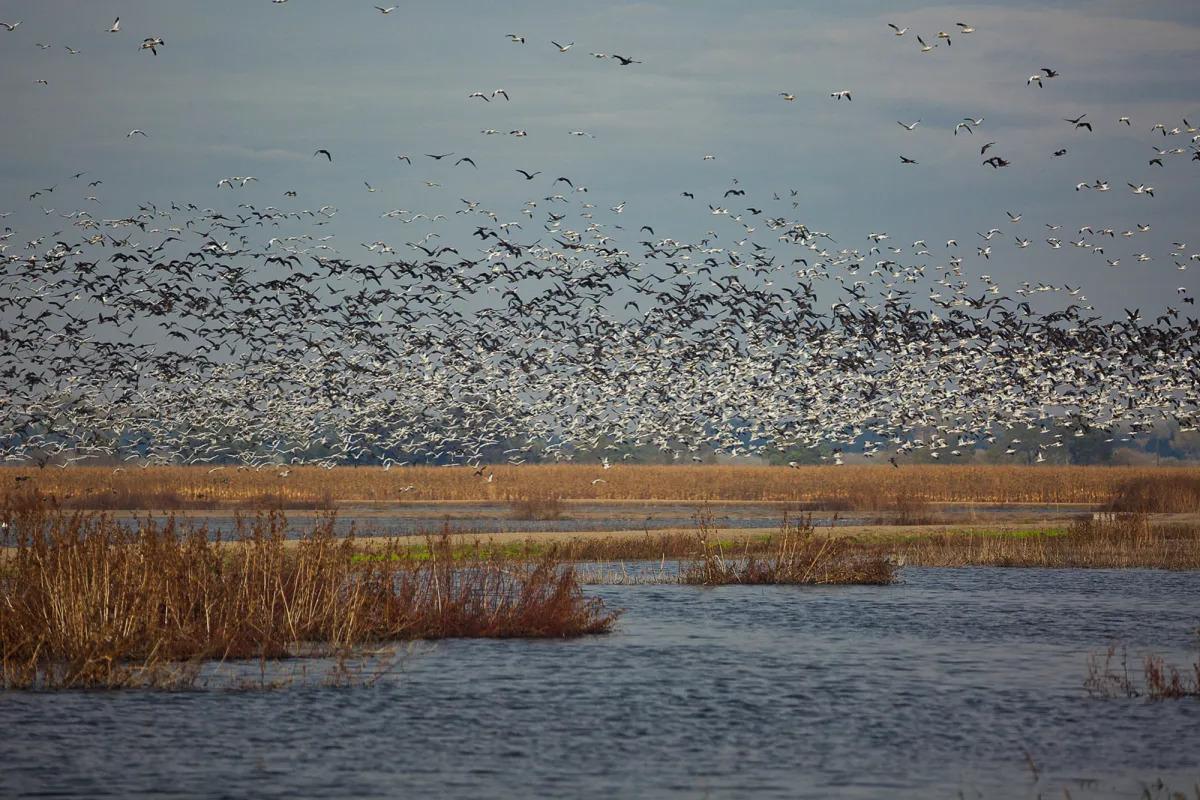
This story was originally published by CalMatters. Sign up for their newsletters. Even on chilly January days in years past, it was possible to see and hear more than 100 kinds of birds at the Vierra Wetlands in the San Joaquin River National Wildlife Refuge. But last winter, dozens of species like the snowy egret, northern shoveler and the strikingly colorful wood duck did not appear. The seasonal wetlands, which are part of a larger pit stop for migratory birds on the Pacific Flyway, were nearly bone dry — and not because of a drought. The U.S. Fish and Wildlife Service simply didn’t have enough employees dedicated to opening the levees that flood the wetlands. It’s a reality playing across many of the national wildlife refuges in the country, including the 35 in California. Labor shortages at the federal government’s various land management agencies — which have intensified in President Donald Trump’s second term — have left departments with less capacity to manage the refuges. What’s left at Vierra Wetlands are dried up cattails and bulrushes standing on a landscape that was once teeming with waterfowl, shorebirds, beavers and other wildlife. And while the wetlands occupy only about 50 acres of the 7,500-acre refuge, the dearth of staffing means there is no on-site refuge manager to readily ensure the land is well-maintained and safe for visitors, organize educational programs for the public, approve permits or monitor habitats for the refuge’s myriad of species. “For an agency that already cut the fat … it’s not even at the bone now,” said Desirée Sorenson-Groves, the president of the National Wildlife Refuge Association, an advocacy organization. “It’s just lopping off limbs.” Eric Hopson had hoped the federal wildlife agency would hire his replacement shortly after he left his post in Central California. The 64-year-old retired in April 2024 after 30 years of service — 23 of which were devoted to stewarding the San Joaquin River refuge, west of Modesto. Unlike coastal counties where state and regional parks are abundant, the refuge serves as a rare open space in the Northern San Joaquin Valley. It also functions as part of California’s vast network of public lands, which overall provide food and sanctuary for countless animals and plants, and protect sensitive habitats and clean drinking water from urban development. Besides interacting with the public like birders and families, Hopson’s favorite part of the job was managing the refuge’s habitats. This entailed diverting runoff water in coordination with adjacent farms, or from Hospital Creek and Ingram Creek. The process mimicked the terrain’s natural water cycles by “flooding up” the wetland basin in time for fall migration during September or October. When spring arrived, Hopson would draw down the water or, in most cases, let the water recede on its own. “Our rivers and wetlands are very altered,” said Hopson. “For that reason, they don’t take care of themselves anymore. So for better or worse, we humans have to take care of the wetlands.” His threadbare staff included just him and one other equipment worker who drove tractors to clear trails, installed pipes for water control and generally served as a jack-of-all-trades. But a year after his colleague retired, Hopson decided he should take his leave too. “My time was up,” he said. The department didn’t immediately hire a successor, which wasn’t so unusual given it was already understaffed. But seven months later, President Donald Trump won reelection. By the time Hopson retired, the country’s wildlife refuge system had already been plagued by a decadeslong staffing shortage that persisted through the Obama and Biden administrations. From 2010 to 2025, national wildlife refuges lost 30% of their staff, according to the National Wildlife Refuge Association. More than half of refuges have zero staff on site — a statistic San Joaquin River National Wildlife Refuge became a part of when Hopson left. “It’s crucial that we have people in those roles to support those ecosystems,” said Matthew Hutchinson, an assistant professor at UC Merced’s life and environmental sciences department, referring to refuge managers. “The planning they have to do to make sure the water is in the right place, at the right time, at the right depth and for the right amount of time is really crucial to the success of these ecosystems. … There is a lot of care for the landscape that goes into this work.” At the start of Trump’s second term, he issued an executive order creating the Department of Government Efficiency within the White House. He tapped tech billionaire Elon Musk to lead a sweeping campaign that they professed would eliminate government waste and fraud. Before it shut down in July, DOGE careened through various federal agencies with little to no oversight, slashing staff, rescinding grants and rolling back initiatives that promoted diversity. Though some federal workers have been reinstated, one recent estimate citing federal data found that DOGE gutted about 350,000 federal jobs. Between 2024 to the end of May 2025, staff at the U.S. Fish and Wildlife Service dropped from 9,957 to 8,179, or 18%, according to the Center for Biological Diversity, a nonprofit advocacy group for endangered species. Policy watchdog groups reported that DOGE hit California the hardest second to Colorado in total public land agencies’ job losses, cutting 14% of staff throughout nine agencies. “The second Trump administration and DOGE accelerated any preexisting challenges through their hiring freezes, their massive workforce reductions and all the restructuring across many federal agencies,” said Mary Lunetta, a national conservation strategist at the Sierra Club. “It left fewer people to maintain everything from mountain trails and campgrounds, to doing critical scientific research and restoration of habitats, issuing permits and fighting invasive species.” A poll released Thursday by the conservation advocacy group Power in Nature found that nearly 70% of California voters surveyed, from both sides of the aisle, want their congressmember to support a bill prohibiting further cuts to park and public lands staff. Hopson doesn’t blame Trump for the department’s workforce shortage, but the situation “just keeps getting worse and worse.” DOGE “got rid of all the temporary and up-and-coming young staff” that did not have protective job status, he said. “These young biologists, these young refuge managers … the younger staff that are the hope for the future and they had their legs cut out from under them.” The refuge receives support from staff at the San Luis National Wildlife Refuge Complex office in Merced County, said the U.S. Fish and Wildlife Service, which is about an hour drive away. It’s not enough to provide the same level of oversight and service as before, said people who use the refuge. In addition to the manual flooding, Hopson prepared special-use permits. These included ones that, for years, allowed the Stanislaus Audubon Society access to count heron rookeries, survey nests and take the public along trails that aren’t typically open, said Sal Salerno of Modesto, the birding group’s president. With Hopson’s departure though, “this year we haven’t done it,” said Salerno. “We just can’t do any of those activities. It’s very frustrating to want to volunteer and help count the birds.” The federal wildlife service did not comment on why the Vierra Wetlands appeared unflooded last winter. After CalMatters’ inquiry, the department said it plans to flood the wetlands this fall and that “the seasonal wetlands continue to provide habitat for upland-dependent migratory birds and resident wildlife.” (Upland is a term to describe areas that lie beyond wetlands or rivers, or above the elevation where flooding occurs.) Experts agreed any amount of water would be an improvement. But restoring a wetland that has been parched for an extended period of time can be complex. Flood a basin too much and it could lead to mosquito issues or water-loving plants outcompeting other plants that are more critical to the ecosystem. Plants that grew over the dry period also may not be beneficial or nutritious for the returning waterfowl to eat. “There are a lot of moving pieces and just because you throw water into it doesn’t mean that it’s going to bring it back to what it was,” said John Veon, a Ph.D candidate in ecology at UC Davis. “It’s not impossible to bring it back 100%, but you do have to sit and think about the challenges.” In the meantime, people can still visit the refuge and walk its trails — it receives roughly 11,000 visits each year, according to the wildlife department — and birds seeking food, rest or a mate can find them within reach at Sacramento or Merced national wildlife refuges. But when the days get colder and the birds in Alaska, Canada and the Arctic begin their long flight down this fall to the Central Valley and beyond, they may find Vierra Wetlands filled with water once again. Until then, the basin remains dry. Hopson, who now lives in New York, visited the refuge a few times when he was back in California. He said the landscape is “sobering,” but empathizes with the public lands workers who are still left standing. “They’re just overwhelmed,” said Hopson. “They’re heroes who are basically trying to … keep the ship from sinking.” This article was originally published on CalMatters and was republished under the Creative Commons Attribution-NonCommercial-NoDerivatives license.‘Humans have to take care of the wetlands’
'Legs cut out from under them'

'Back to what it was'

–
Stay up to date on business in the Capital Region: Subscribe to the Comstock’s newsletter today.
Recommended For You
Can a Luxury Hotel Turn Tiny Hood Into a Delta Destination?
A 64-suite hotel with a spa, restaurant, lounge and marina is planned for the Sacramento River town
Former police officer and current real estate developer Robert
Leach is making a multimillion-dollar bet in Hood, a
Sacramento-San Joaquin Delta community with just 244
residents
Scientists Attest to Value of UC Davis Smelt Lab
Federal funding has been imperiled for facility near Byron
The San Francisco Chronicle reported on Feb. 6 that the federal government was looking to not renew funding for the UC Davis Fish Conservation and Culture Laboratory after its current round expires on Friday. While sources close to UC Davis are confident of a new contract being signed with the U.S. Bureau of Reclamation, that hadn’t happened as of press time, and some are worried about what comes next.
Tribes and Allies Form a Coalition Against the Delta Conveyance Project
The Winnemem Wintu, Shingle Springs Band of Miwok Indians and other groups oppose plans to build the Delta tunnel
Southern and Central California water districts say they need the Delta Conveyance Project to withstand drought and climate change, but opponents say it will drain vulnerable ecosystems.

The Delta in Decline
Wildlife and businesses in the Sacramento-San Joaquin Delta are suffering from lack of fresh water
The life cycle of a salmon, so the story goes, is a heroic journey. The fish emerge from fertilized eggs in a river bed, swim to the ocean where they spend most of their lives and return to give birth in the exact place where they were born.
Delta Blues
The battle over water has been fought to a standstill, but there’s hope that science and technology will make voluntary agreements by all sides possible
For decades, the California water debate revolved around one metric: unimpeded flow, which is the amount of water in the river and streams. While flow is still without doubt the key issue, it is no longer the only one.
This Collaboration Between Farmers, Water Officials and Environmentalists Is Saving Wildlife
The Floodplain Forward Coalition helps farmers help salmon while protecting water supplies
Water policy in California is defined by fighting. Plans to fix the system languish for decades, and if they’re implemented, they end up in court for many more years. The Floodplain Forward Coalition has broken out of that paradigm.