


This story is part of our February 2026 issue. To read the print version, click here.
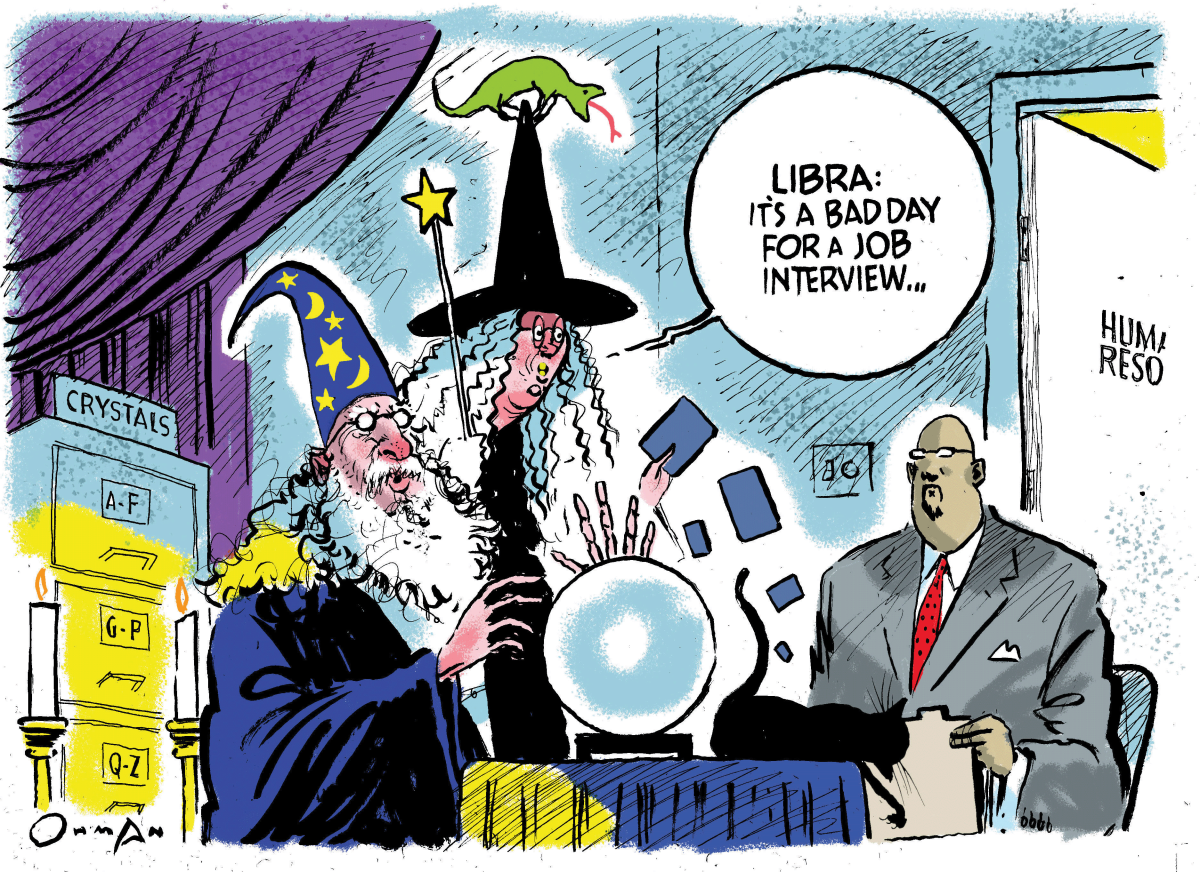
I had a second-round interview at a top-tier company, and the final question completely threw me off: “What’s your astrological sign?” It felt unprofessional and, honestly, a bit disrespectful for a serious interview. Curious your thoughts — red flag or harmless curveball?
Answer: Yes.
The average manager only interviews people about once a year, so they might not know what they’re doing when it comes to this (perhaps dreaded) duty. This doesn’t mean they’re a bad boss or that the company isn’t a good one.
In your case, it could mean that this person will be a nightmare boss who checks their horoscope each morning and assigns work based on the predictions. Or it could mean they’re nervous and making small talk. It’s hard to tell off this one question.
Since lots of people face dumb questions in interviews, let’s tackle how to answer them.
Your original question: What’s your astrological sign?
There are a couple of great ways to answer this. One is to play it straight and tell your sign. If you say “Aquarius,” and the interviewer says, “I KNEW it!! You part your hair on the left!” then you’ve just learned something very valuable: This manager will rely on silly things to make decisions.
If they reply with something nonchalant, like “Cool,” or “Oh, I’m a Libra,” then follow up: “Why do you ask?”
Is it possible that there could be a legal snare? If you said, “My religion prohibits me from discussing astrological signs, as I don’t believe in it,” then that would be protected. But as a general rule, which month you were born in isn’t protected, and so a boss can technically refuse to hire Libras.
That said, do you want to work for a company that hires based on the zodiac?
The “gotcha” question: Without Googling, how many teachers are there in Cleveland?
These kinds of questions were popularized by tech companies wanting to see how you worked through a problem: Define what they mean by teacher (who is included? Daycare, K-12, college, dance teachers, etc.), estimate the number of students, figure out how many teachers per student and give an answer. That’s probably what they are looking for.
If you are a risk-taking kind of person, then say “15,321” confidently. Then explain, “This is precisely the kind of question you should Google, but if you’d like me to explain how I work through the type of problems I would likely face in this position, I’m happy to do this.” Then walk through your problem-solving steps.
The “psychological insight” question: What was the last book you read?
When managers ask this type of question, they think the answer will give them huge insight into who you are as a person. Are you the type who reads Dostoevsky for fun or the type who hasn’t touched a book since you finished undergrad? Do you read romance novels or religious tomes?
You can give a truthful answer and let the chips fall where they may, or mention the last business book, or the Sandra Boynton book you read to your toddler. Then ask them the question back.
And if there’s a lull, perhaps follow up with, “What type of person thrives in this role?” After they answer, explain why you are a good fit. Their book question was a pop culture way of getting psychological insight, so give them a chance to get it in a clear way.
The borderline illegal question: Do you have children?
California law prohibits family status discrimination, so you, probably rightly, cringe at this question. But, like all protected status information (race, sex, religion, etc.), asking the question isn’t illegal; using the information to make a decision is.
Sometimes this question is part of casual conversation. If you just said the last book you read was “Moo, Baa, La La La” (a classic), the follow-up question of “How many kids do you have?” is probably casual conversation, and you shouldn’t worry about it. If, instead, the previous question was completely unrelated, then this is a red flag that you should respond to very carefully. “Is the answer related to the job?” you can ask.
If this question comes from a hiring manager, report it to their higher-up or the recruiter. The manager needs more training.
Likewise, a question like “Where are you from?” shouldn’t be taken as anything untoward, unless it gets weird, such as they pressure you to tell where your ancestors came from or to sort out if you speak Spanish. Then call it out as inappropriate.
But if you answer “Roseville,” and the hiring manager responds in a way that indicates they are trying to build a relationship, like, “Oh, which high school did you go to? I went to Granite Bay,” then it’s probably benign.
Job interviews shouldn’t be adversarial, so don’t take them as such. Do make notes of any weird or inappropriate questions, but keep in mind that most hiring managers are just terrible at interviewing. So that bizarre question probably means nothing.
–
Stay up to date on business in the Capital Region: Subscribe to the Comstock’s newsletter today.
Recommended For You

Our Company’s Name Is Being Used by Job Scammers. What Can We Do for Damage Control?
Dilemma of the Month: What can companies do when scammers are impersonating them on job sites?
Job seekers need to keep vigilant, but there are several things
you can do to help make that easier.

Employees Aren’t Washing Their Hands. Is It My Job as HR to Tell Them What They Should Have Learned in Kindergarten?
Dilemma of the Month: The Evil HR Lady addresses personal hygiene in the workplace
While I agree that non-handwashers are gross, the reality is that life is gross.
My Boss (Who Has ADHD) Bombards Me With Rapid-Fire Requests. Can I Ask Her to Slow It Down?
Dilemma of the Month: The Evil HR Lady discusses neurodiversity in the workplace
Understanding neurodiversity doesn’t mean putting people into two categories: neurodiverse and neurotypical. Let’s break it down.

Dilemma of the Month: An Employee Accidentally Shared an Email With Sensitive Data. How Can We Know It Won’t Happen Again?
The Evil HR Lady addresses apologies and how to take them
If you’re looking for groveling — well, that’s a problem on your side too. Let’s break this down.