


This story is part of our December 2025 issue. To read the print version, click here.
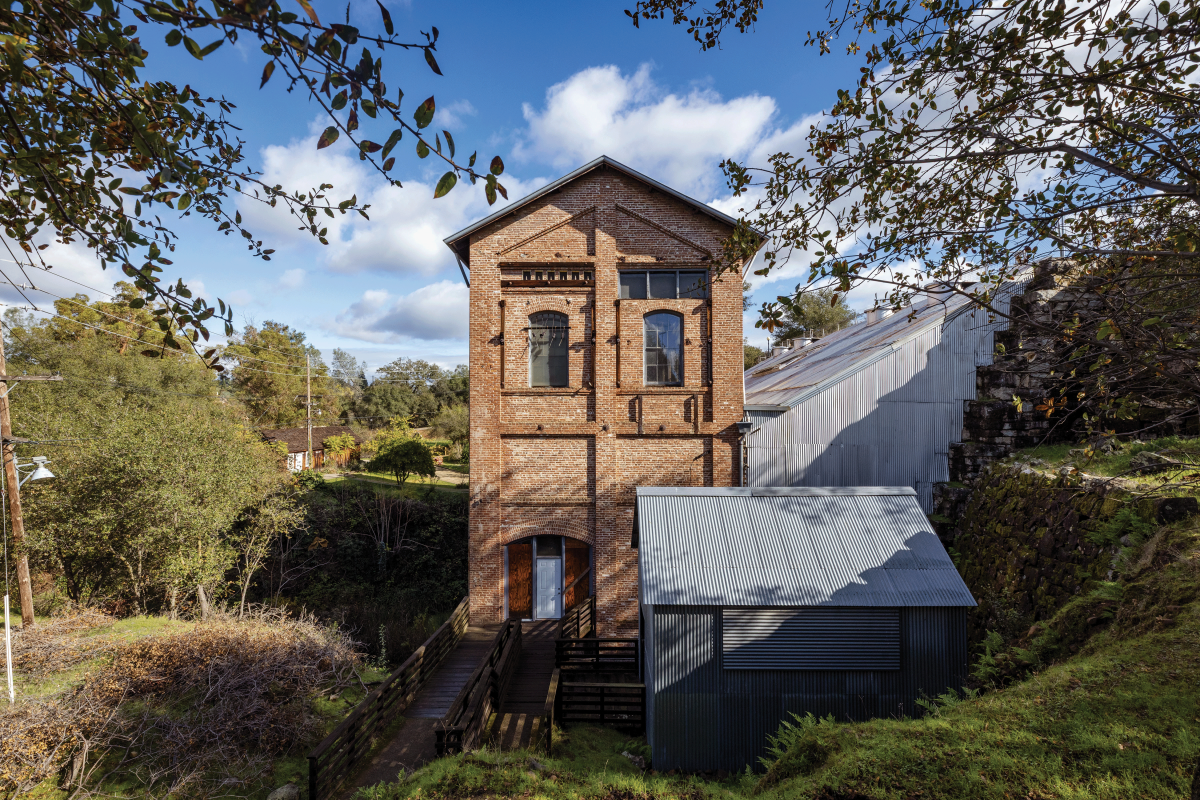
The City of Folsom is notable for several attractions, including that legendary gated community called Folsom State Prison, and is a magnet for freshwater sports such as boating, kayaking, swimming, paddleboarding and sculling. It’s also the home of one of the region’s most generous retirees, the Folsom Powerhouse. The former utility is a celebration of an earlier time’s creative engineering and is now a verdant state park and learning center just above Lake Natoma. It’s 20 minutes east of California’s capital at the hilly entrance to the magnificent Sierra Nevada.
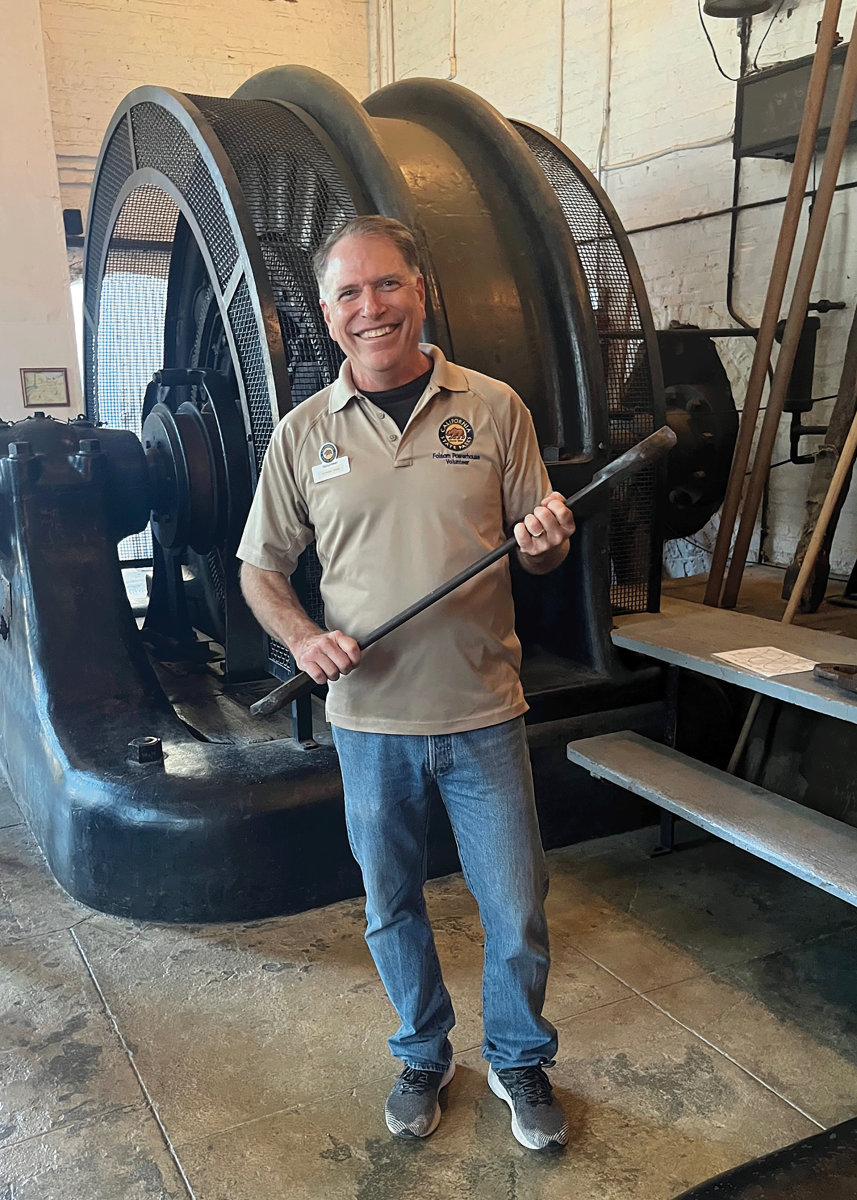
On a recent Saturday afternoon tour of the Folsom Powerhouse, our tour guides are Nicole Barden, a State Parks interpreter, and docent Kevin Sigl, a retired electronic engineer who spent 20 years with Hewlett-Packard, who says, somewhat tongue-in-cheek, that his professional experience “doesn’t qualify me for this job.”
Docent Kevin Sigl is a retired electronic engineer who spent 20
years with Hewlett-Packard.
Built in 1895, the powerhouse was shut down 73 years ago, concurrent with the demolition of the original Folsom Dam. In its operative years, the Folsom Powerhouse was an alternating current, or AC, power station — one of the first in the country, though not the first, as tour guides are quick to point out. (Thomas Edison’s Pearl Street Station in New York City began operating in 1882.)
“There was also a little something called Niagara Falls,” which began operating a powerhouse around the same time, says Sigl. He leads tours of the station, a two-story brick building lined with still-sturdy granite walls and externally preserved, if no longer operative, machinery.
“It would cost a fortune to put any of this back into operation,” says Barden, whose title of “interpreter” covers a variety of duties, including being one of the facility’s on-staff tour guides and liaison to the news media and community.
Before the Folsom Powerhouse was built, most electrical power was generated by the less-effective DC (for direct current) system. When AC came along, electrical power could be amped up to a much higher voltage, deploying transformers (another new invention at the time) along the way to send power much farther.
Stepdown transformers at Folsom Powerhouse in the 1890s. (Public
domain via Wikimedia Commons)

Transformers also converted high-voltage power to lower, safer power. The Folsom Powerhouse took advantage of the mighty American River’s cascading water to power its turbines, which were connected to generators, another innovation. It was 55 years since the Industrial Revolution, which ran from roughly 1760-1840, had officially ended. Engineers in the electric power field must not have received the memo. If ever there was an example of exceptional innovation, the Folsom Powerhouse remains as a standing reminder of that era.
Which is not to say that this wasn’t a dangerous time for workers. Since the powerhouse had already stopped operating almost 20 years before the dawn of OSHA — the government watchdog for injury-on-the-job prevention — accidents weren’t uncommon (or rigorously reported) in its day. Guides Barden and Sigl share stories of electrocutions (a few fatal and one that sent a worker soaring through the air and, miraculously, landing intact), a severed-leg tragedy and mild-to-major calamities caused by a variety of jolts and volts.
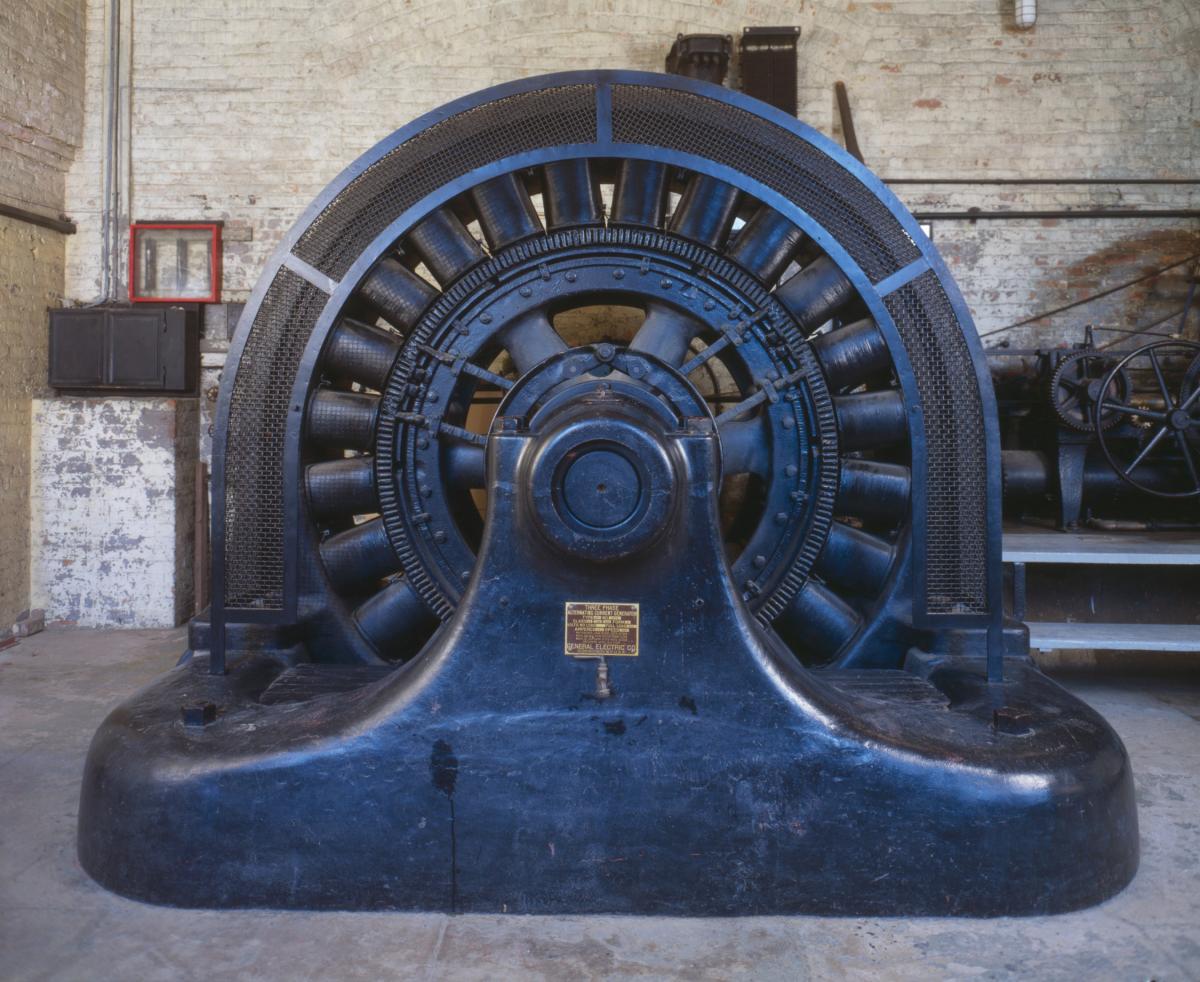
An electric generator in the Folsom Powerhouse. (Shutterstock
photo)
Asked if the people who worked at the powerhouse were journeyman electricians or students who’d studied the science in college, Sigl smiles and shakes his head no. “The supervisors probably came from other power companies,” he says. “But the average day worker was just that: a day worker.” A moment later, he adds, “This wasn’t a popular place to work because of the danger and the strangeness of it. You’d be better off getting a job on a farm or at a store in town.”
A tour of the powerhouse itself is a daunting reminder of a time when American industry was highly visible — you could actually see why this motor affected this lever, which triggered this function, as opposed to the largely hidden ingenuity of the computer age, which most of us take for granted. Yet unlike many historic attractions, Folsom Powerhouse boasts an artistically conceived and executed visitor center filled with displays that explain in words and pictures how street lights were powered and trolleys ran more than a century ago.
The brochures and exhibits in this airy building remind us that Engineering News-Record magazine named the Folsom Powerhouse the world’s best engineering project in 1895. For comparison’s sake, this was in the magazine’s listing of a century-and-a-quarter’s worth of engineering achievements — which included the not-exactly-shabby Panama Canal and Eiffel Tower.
Folsom Powerhouse’s marvels weren’t lost on the newspapers of the time. In 1895, an electric light parade drew an estimated 30,000 visitors to Sacramento. Featuring floats illuminated by thousands of bulbs, it was held to celebrate the arrival of electrical power to the capital.
An invitation to the 1895 Grand Electric Carnival features an
inset illustration of Folsom Power House. (Public domain from the
Special Collections of the Sacramento Public Library)
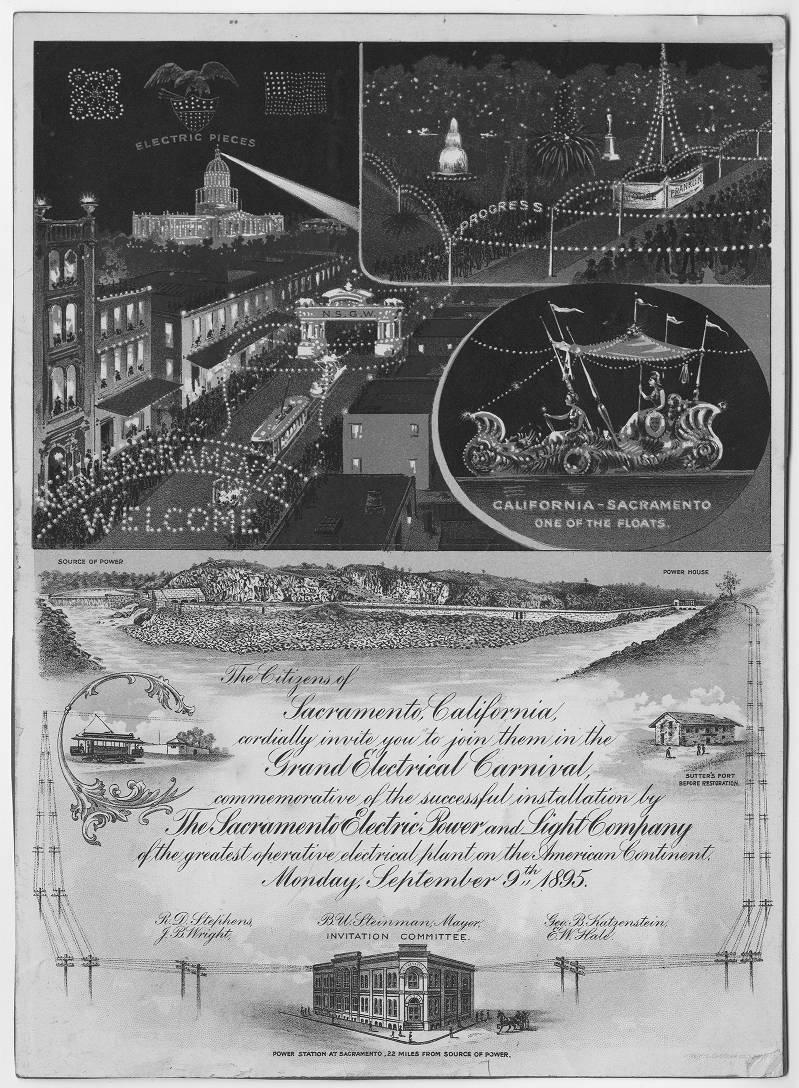
It became a front-page story for both the Sacramento Bee and the late Sacramento Union — and if you find a Disneyland employee willing to talk on background, you may hear that the Folsom/Sacramento celebration was the inspiration for latter spectacles, which took place at the Disney parks in Anaheim and Florida. Wouldn’t it have been nice for one magical kingdom to honor an earlier one?
Folsom Powerhouse by the Numbers
- In 2024, a total of 30,000 visitors either stopped into the visitor center or toured the powerhouse — or both. A staff member says they expect the 2025 average monthly visits to hit 2,600.
- Among the highlights of the Folsom Powerhouse tour is an enormous switch, a flip of which could literally turn all of the power on and off in Folsom, Sacramento and its surrounding communities.
- Barden says her office “would love to have more volunteers” who’d be trained to lead tours of the powerhouse but also help staff its visitor center. She can be reached at (916) 856-8952.
- There’s a $10 parking fee at the Folsom Powerhouse but the tours — which can be arranged by contacting interp@parks.ca.gov — are free. That’s a pretty powerful offer.
–
Stay up to date on business in the Capital Region: Subscribe to the Comstock’s newsletter today.
Recommended For You
Sutter’s Fort Returns to Its Roots: Authenticity Wins Out Over Mythology
Schoolkids still find it a delight, even without living history characters
The Back Story: Sutter’s Fort, the 6-acre state park in Midtown Sacramento, is an underappreciated jewel in the crown of the region’s historic attractions.
When Streetcars Roamed the Capital Region
The classic car system predated light rail by almost a century
While many of us believe that Sacramento’s light rail trains were innovative when they began tooting their way throughout the Capital Region in the 1980s, the current system is actually the reboot of a suburban trolley that slid, wended and awoke its way through the area many decades before.
The Violent, Bloody Folsom Prison Escape of 1903
New book details a dark time in the prison’s history
The prisoners made makeshift knives, or shivs, and used stolen razors during their siege. One prison guard died, and two were injured.
Whatever Became of the Auburn Dam?
One of the largest flood control projects in the country was never built
The Auburn Dam could well be the most talked about water storage and flood control facility in the country that simply doesn’t exist — no matter how much it’s been argued about, advocated for and against, legislatively proposed and architecturally rendered.