


This story is part of our March 2026 issue. To read the print version, click here.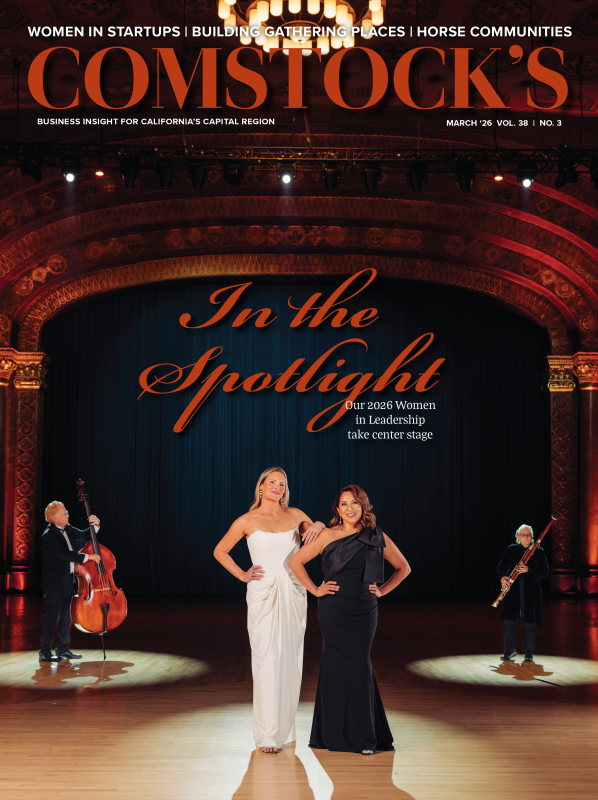
Get to know our 2026 Women in Leadership during a reception at Scott’s Seafood on the River in Sacramento.
Read about the honorees here.
Know an emerging leader who deserves recognition? Nominate a Young Professional before April 15.
For past and future episodes, follow us wherever you listen to podcasts, including Apple Podcasts, iHeart, and PocketCasts.
Transcript:
Dakota Morlan: All right, so we’re here at Scott’s Seafood on the River in Sacramento, celebrating our 2026 Women in Leadership — who you can read all about in our March issue and at comstocksmag.com. This year we feature 10 impressive women who are guiding the future of the Capital Region and beyond. Our first volunteer as tribute for this evening is Sadie St. Lawrence, founder of HMCI, the Human Machine Collaboration Institute. Hi! How’s your night going?
Sadie St. Lawrence: Oh my gosh, so fun. Women’s events are my favorite — so many great outfits, everybody’s so friendly. It’s just a different vibe. It’s really fantastic.
Dakota Morlan: So I told you this earlier, but you were one of my favorites from the photo shoot. For those who don’t know, we did our shoot at the Memorial Auditorium in Sacramento with the Philharmonic. Each woman we were honoring was photographed in a pantsuit or ball gown in a different area of the auditorium, with an accompanying musician. Who was your musician?
Sadie St. Lawrence: I don’t know their name, but I know it was cello. Having done different photo shoots before, this was the best ever — they actually played the whole time, so the vibe was just next level. It’s a beautiful space, and the Sacramento Philharmonic Orchestra is so good. Everybody should go see them.
Dakota Morlan: It was really cool. I was there for part of it, and hearing them serenade us while watching you all strike poses — very chic. So I have some speed questions for you. A couple are tailored to you specifically, and a few I’ll just pull from the list. First: you work on the cutting edge of AI. What is one myth about AI you’d like to put to bed?
Sadie St. Lawrence: This is going to sound crazy, but — that it’s “artificial” intelligence. I think the name we picked for it is one of the things most wrong with it. It makes AI seem like this far-out, alien thing that people can’t use, when the reality is it’s just computer programs that do useful things for humans. The whole industry needs a rebrand. And I say that as someone who named their company one of the longest names ever — all of us in tech are just bad at marketing and branding, so please come help us. The name makes people think it’s some alien intelligence, and it’s just not.
Dakota Morlan: If you could come up with a different name, what would it be?
Sadie St. Lawrence: I really like “applied intelligence,” because that puts into perspective that the human is still in the loop — you have to apply that intelligence to whatever you want it to do for you. You still get the acronym AI, but it reframes what that stands for. It’s not artificial; it’s however you want to apply it and where you find benefit. That’s my pitch as a non-marketer, so I’m inviting any marketers in the room to weigh in.
Dakota Morlan: One more AI question, because it’s all anyone talks about these days. Which industries do you think AI will have the most positive impact on, and why?
Sadie St. Lawrence: Definitely bioscience and healthcare. We’re almost at a point where we can get really specialized algorithms tailored to individuals’ personal needs. Just two weeks ago, someone used ChatGPT to describe what was wrong with their dog and created a custom vaccine for it. Yes, it’s one pet and a one-off case, but it shows that when you have custom solutions and all that background data, you can really deliver tailored results for people. That’s why I hope we see a lot of change because of AI.
Dakota Morlan: And what AI applications do you use most on a regular basis?
Sadie St. Lawrence: I started with ChatGPT, and now I use Claude — Claude Cowork and Claude Code. Whenever I go back to ChatGPT, it’s like going back to an old boyfriend. I’m like, “I knew you. I started with you. I have memories with you.” And then it goes bad and I remember why I left — too many emojis. I really love Claude’s artifact creation, so that’s what I’m using right now.
Dakota Morlan: Maybe I need to get on Claude and stop paying for ChatGPT. All right, now some random hot seat questions. What do you do when you’re stuck on a problem?
Sadie St. Lawrence: Two things. If I’m stuck on something I’m frustrated with, I take a break and go work out. And if I’m stuck and need outside-the-box solutions, I talk to my husband — he’s the best out-of-the-box thinker and will push me toward a completely different angle.
Dakota Morlan: How do you relax and de-stress at the end of the day?
Sadie St. Lawrence: Typically, a glass of wine by the pool and doom-scrolling — nothing healthy at all. In the morning it’s gym and workouts, healthy things.
Dakota Morlan: One more and then I’ll let you go. What is one decision that changed the trajectory of your career?
Sadie St. Lawrence: The big one was the first time I left corporate America and committed full-time to the first organization I founded, Women in Data. It was such a scary jump — I had a great job in AI and consulting, and I left with about three months of runway. But it gave me confidence in myself, and it reaffirmed that whenever you go after something you truly believe in, the universe finds a way to help you. It built a lot of my faith and confidence.
Dakota Morlan: And you’re from Iowa, right? Do you agree that Sacramento is the Midwest of California?
Sadie St. Lawrence: I mean, I haven’t been everywhere in California, and some people say Bakersfield or other places — I don’t know. But I love Sacramento because everyone has that friendly Midwest vibe, and yet you still get all the opportunity that California offers. It’s the best of both worlds.
Dakota Morlan: Nice and flat, with the trees —
Sadie St. Lawrence: So many trees! That’s one of the reasons I moved here. And you can see the mountains — on my drive to work I can see the Sierras, which is great.
Dakota Morlan: Well, thank you so much for sitting down with us. Enjoy the rest of the party, and feel free to do some recruiting if you run into any other ladies — it’s not so scary.
Sadie St. Lawrence: Thank you! It wasn’t scary at all.
Dakota Morlan: The other editor and I had a big argument over where Midtown is and how big it is.
Emily Baime Michaels: What did you decide?
Dakota Morlan: I decided it’s roughly the eastern half of the grid — because colloquially, if you’re living in Midtown, you refer to that whole area as Midtown. I understand it keeps expanding, but she validly pointed out there’s an official neighborhood called Midtown, and I technically live in Newton Booth, along with all these other distinct neighborhoods. I also argued that your service area goes all the way up to the top of the grid and edges into East Sac. So it’s really more of a feeling. How do you define where Midtown is?
Emily Baime Michaels: I agree with your definition — roughly from 16th Street over to the edge of the commercial area going into East Sacramento. She is right that there’s technically a neighborhood by that name, and that’s the commercial core. But from my perspective, that’s the residential neighborhood distinction, as opposed to the broader commercial and residential interest area.
Dakota Morlan: When do you think it became so big? Most people, if you ask them, would say “I live in Midtown” even though they technically live in another neighborhood.
Emily Baime Michaels: I think it’s similar to a lot of cities where the mid-central area just gets called Midtown. As that area has expanded — more development, more bars, restaurants, energy — the name was naturally adopted. I’m not sure there was ever a moment we sat down with a pen and officially declared, “This is Midtown.”
Dakota Morlan: So as an organization you get to just define it, because there’s nothing governing it — like, you can’t cross the freeway and suddenly not be in Midtown anymore.
Emily Baime Michaels: Right, there’s no law or wall that comes down. There’s also the question of where we deliver service. Part of our area includes the Alhambra corridor, which I’d say is part of the central city, but not necessarily part of Midtown.
Dakota Morlan: I’d agree that 16th Street is the cutoff for sure. So what are you excited about this summer in Midtown? Because it’s already summer.
Emily Baime Michaels: The thing that’s top of mind right now — we’ve been in nonstop meetings about it — is a large art installation coming to Midtown. It’ll be at Fremont Park, at 16th and P Street. There will be 30 large sculptures, anywhere from six to about 12 feet tall. The installation is called Fremont Bloom, and it’s modeled on the California State Poppy. So there will be 30 massive illuminated poppies you can picnic and play under, with free yoga, nighttime yoga under the lights, and several community picnic events. That’s what has my attention at the moment.
Dakota Morlan: I was actually quite upset that I missed the octopus on top of Mulvaney’s. When you mentioned it I thought, “We don’t get out enough — we need to see these things.”
Emily Baime Michaels: Well, you’ll have to come out to this one. It’ll be there from the second Saturday of May through the second Saturday of June. It’s free and open 24 hours. Just go see it.
Dakota Morlan: Amazing. And I just realized I didn’t introduce you for the listeners — I’m sitting with Emily Baime Michaels, Executive Director of the Midtown Association. Now I have a few speed questions I’ll pick at random. What’s something the next generation — Gen Alpha, I suppose — is getting right, in your opinion?
Emily Baime Michaels: I see people moving away from competing with each other toward figuring out how to collaborate so more people win. That gives me a lot of hope.
Dakota Morlan: Are you basing that on any children you know in particular?
Emily Baime Michaels: My niece at four is a lot sweeter than I was at four. So there’s that.
Dakota Morlan: Name three non-office-related items currently in your office.
Emily Baime Michaels: I have a large amethyst rock from my mom’s garden that sits behind me. I always have candles — maybe not technically office-related, though I do buy them from my favorite vendor at the Midtown Farmers Market. And I have a card from the last time I played Cards Against Humanity with my dad. He was a little tipsy — he never drinks — and he pulled a card that just said “some goddamn peace and quiet,” started laughing, and threw it on the table. I saved it in a baseball card holder and keep it in my office.
Dakota Morlan: Very nice. Last question: was there something you cared too much about earlier in your career that you now realize wasn’t so important — or vice versa?
Emily Baime Michaels: Getting things perfect. I used to spend so many more hours trying to get every little detail exactly right. I think that’s common among a lot of women — this idea that you have to have everything just so and constantly prove yourself. Once I stopped coming from that place and became more authentic — which is imperfect, humorous, a little crude sometimes, just honest — I felt much more aligned with the work I do.
Dakota Morlan: Awesome. Well, thank you for taking the time to sit down. These are the best seats in the house. Cheers!
Now I’m sitting with Beth Hassett, CEO of WEAVE, which is the primary provider of crisis intervention services for survivors of domestic violence and sexual assault in Sacramento County. Beth, thank you for joining me. How do you stay centered and balanced in a career that can be emotionally taxing?
Beth Hassett: I surround myself with people who keep me sharp and lift me up. As you progress in your career and life, you find there’s no reason to keep people around who don’t fill you up — my work is hard, and I want people who are on the same page and who can lift me up.
Dakota Morlan: What’s one way that leaders can better support women right now?
Beth Hassett: Women supporting women is one of the most important things we can do in this community. Being a mentor to other women, regularly sharing wisdom with those who are earlier in their careers, and bringing women together — both for fun and to talk about the real struggles of being a leader or a leader on the rise.
Dakota Morlan: What is your favorite part of your workday?
Beth Hassett: I love that no two workdays are ever the same. I love a day where I’m in the office getting things done and people can come talk to me. But then, like today, I drove 57 miles back and forth all over Sacramento County — and that’s invigorating too. It just keeps me on my toes.
Dakota Morlan: This is kind of a two-part question. How do you know what to prioritize day to day, and how do you make time for those priorities?
Beth Hassett: I prioritize the things that could get something shut off, canceled, or get us in trouble — compliance comes first. But I also prioritize the people around me. A lot of my job is supporting people who support other people, so really slowing down and being present — which isn’t my natural state — is a skill I’ve had to work on. People want to be seen and heard, and I think that’s one of the most important things I do daily. I’ll prioritize that over finishing a grant report or returning a call that isn’t urgent.
Dakota Morlan: Any life hacks you’ve discovered around doing things that don’t come naturally to you?
Beth Hassett: In my early 40s, I felt like I was sometimes being a fake version of myself — trying to be professional, trying to be this or that. Really leaning into who I actually am — casual, but deep, someone who wants to be around people who care about important things — and just owning that, has been the biggest shift. As women, we can try to put on a little suit and play the businessperson, but ultimately, leaning into your superpowers — whether that’s being warm, connecting people, or seeing the bigger picture — rather than trying to be someone you admire is far more powerful.
Dakota Morlan: Last question — what do you hope your legacy is?
Beth Hassett: I hope my legacy is that I was a true friend and a true partner in this community — someone who helped activate it and get things done. That’s the legacy I hope for.
Dakota Morlan: Thank you so much for taking the time.
Now I’m sitting with Dr. Kennedy Hill-Garcia, Government Relations Consultant at Kaiser Permanente and founder of the REIGNWell Institute. Thanks for sitting with me and taking some time from the party. You also have another title, correct?
Kennedy Hill-Garcia: A former title — they mentioned in the introduction that I was Mrs. California International 2023. I’ve actually held seven titles in pageantry, and that’s just the one I love most.
Dakota Morlan: But you don’t keep the title forever — the year is attached to it, right?
Kennedy Hill-Garcia: Right, you’re always the former Mrs. California International. I got to crown a successor in 2024, and she went on to compete at the Mrs. International pageant. The legacy continues.
Dakota Morlan: Can you tell me a little about the REIGNWell Institute?
Kennedy Hill-Garcia: I’m so glad you asked. The REIGNWell Institute is an extension of a nonprofit I started in 2017 called the Dream Academy. My goal was to close the gender dream gap for girls. By the age of seven, girls actually stop dreaming about what they can become — because someone has already told them it’s not possible, whether at home, at school, or through peers. Boys, by contrast, continue to dream through adolescence and into adulthood. I wanted to make sure girls understood that whatever they wanted to be was achievable, and more than just raising awareness, I wanted to build a program to help them develop the skills needed to pursue those dreams. I created leadership development curriculum, hosted workshops and college campus tours, and developed a scholarship fund for girls graduating high school and entering four-year universities — because sometimes it’s easier to get into school than to stay in school. The scholarship renews each year so they can continue their education. The REIGNWell Institute brings all of that together online so girls can access it from anywhere in the world.
Dakota Morlan: You’re such a great example of doing it all. A lot of women in professional settings feel pressure to conform to a very “businessy” standard. How do you harness your femininity in your leadership?
Kennedy Hill-Garcia: My favorite word for how I’ve done that is intentionality. I have intentionally made sure I show up in a way that celebrates the woman I am, regardless of who’s at the table — and usually I am the only person at the table who looks like me. I show up as I am, instead of trying to mimic male leadership the way people before us sometimes did. I’m ten toes down as an advocate for women and girls, in every boardroom and on every stage, and I bring a feminine perspective to every conversation — and I want that perspective to be seen as just as important as any other.
Dakota Morlan: Rapid fire! What’s one thing about pageants that people don’t know but you wish they did?
Kennedy Hill-Garcia: These women are powerhouses. They’re impactful. They’re usually founders of nonprofits or doing significant community work — presidential service awardees, the list goes on. The public only sees a beautiful woman on stage in a gown or swimsuit. No one gets to see the behind-the-scenes impact except those of us who are in it.
Dakota Morlan: What are three essentials you always carry with you?
Kennedy Hill-Garcia: My father was a retired law enforcement officer, and when he passed away, his retirement badge was gifted to me by his department. I carry it everywhere — it’s the only thing in my purse I truly care about. My husband asked me the other day what I’d grab if our house were on fire, and I told him: him, and my dad’s badge. Everything else can be replaced. The second essential is lip gloss, because a girl can’t be without some glam on her lips. And the third is my cell phone — I don’t memorize numbers and I’d be completely lost without it.
Dakota Morlan: I swear I go 10 minutes without lip gloss and I feel like I’ve been in the desert. And my final question: what does good leadership look like in practice?
Kennedy Hill-Garcia: Action. Good leadership is not title-driven. It’s not about what you say — it’s about what people can see. What are you modeling? I live by the theory that there are no bad bosses, only bosses who teach you what kind of leader you want to be and what kind you don’t. Both are necessary and both are good for your career and your life, because it’s all a learning process. The great leaders I know lead by action and embody the characteristics you want to emulate. That’s a real leader.
Dakota Morlan: I’m going to add one more — who is someone you really look up to or who has had a big influence on you?
Kennedy Hill-Garcia: I didn’t have to look very far for that. My mother. She only had a junior college education — no PhD, no doctorate — but she is the wisest person I’ve ever met. She could see things before they happened and prepare you for them. She was always in tune with what was going on inside of you, and she nurtured who she thought you wanted to become, not who she thought you should become. She was ahead of her time — the kind of mom who would leave sticky notes in your lunchbox saying, “You’re going to do amazing things today.” That kind of encouragement and affirmation for a young girl is life-changing. She was a great example of selflessness, empathy, and developing people, and I give her full credit. I thank God every day for the parents I had.
Dakota Morlan: What a great note to end on. It was a pleasure meeting you. And for listeners — for more on topics like this in the Capital Region, visit comstocksmag.com, where you can also subscribe to the print edition. See you later!
Hosted by Dakota Morlan
Produced by Dominic Tassinari and Dakota Morlan
Music: Time Out by Atch (CC BY 3.0)
Recommended For You
Sadie St. Lawrence Is Bridging the Gap Between Humans and AI
Women in Leadership 2026: Meet the founder and CEO of the Human Machine Collaboration Institute shaping how society works with artificial intelligence
Raised on an Iowa farm and trained as a musician, Sadie St. Lawrence went on to become a global leader in data science education and AI strategy.

How Emily Baime Michaels Helped Midtown Sacramento Become a Food and Arts Destination
Women in Leadership 2026: Meet the Sacramento leader who put Midtown on the map
Emily Baime Michaels calls Midtown an “urban village,” a fading vision of American life that still exists here.
Beth Hassett Leads WEAVE’s Mission to Support Survivors Across the Sacramento Region
Women in Leadership 2026: Meet the longtime WEAVE CEO who has spent two decades expanding services for survivors of domestic violence and sexual assault
After first joining WEAVE as a fundraiser in the 1990s, Beth Hassett returned to lead the organization.
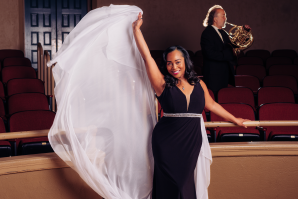
Kennedy Hill-Garcia Is Opening Doors for the Next Generation of Students
Women in Leadership 2026: Meet the Kaiser Permanente government relations consultant and pageant winner who founded a mentoring network
Kennedy Hill-Garcia has mentored hundreds of students while building programs designed to support future leaders.

Athletic Wolves With Steve Martarano and Judy Farah
PODCAST EPISODE: Editor Judy Farah, Managing Editor Dakota Morlan and contributor Steve Martarano discuss April’s cover story on the A’s, the gray wolf’s California comeback and whether or not dire wolves are a good idea.

Predicting the Economy With Steven Yoder
PODCAST EPISODE: Predicting the future is hard, but we still like to try. Comstock’s contributor Steven Yoder breaks down his cover story “New Year, New Administration. What Can We Expect?” in which economists offer their insight on the next few years in the Capital Region. Which areas will see the most growth? Is it time to make the big moves or to play it safe? Find out in our latest episode.

Women in Leadership 2025 With Cassandra Jennings and Yvonne Pire
PODCAST EPISODE: How do you lead diverse teams with differing opinions? Where do you find the confidence to make big career moves? Are women leaders expected to be nicer than men? Comstock’s Women in Leadership honorees Cassandra Jennings and Yvonne Pire join us for a special episode recorded in the wine cellar at Mulvaney’s B+L in Midtown Sacramento.

Is Our Future Tied to the Tracks? with James Stout
PODCAST EPISODE: Journalist James Stout delves into his latest feature for Comstock’s “What’s Holding Up Valley Rail?” where he investigated delays in railway expansion throughout the Central Valley. We discuss the hurdles that are baked into the system, changing attitudes towards public transit and whether hopping on a train might be more commonplace in future America.
Bio-informed Flight with Christina Harvey and Michelle Hawkins
PODCAST EPISODE: UC Davis faculty members Christina Harvey, an aerospace engineering expert, and Michelle Hawkins, director of the California Raptor Center, discuss a Defense Department-funded research project to inform future drone technologies.