


This story is part of our May 2026 issue. To read the print version, click here.
They found her partial remains off a mostly unpaved road that’s choked with manzanita and hooded by moss-flecked oak branches. It was the start of spring when her bones were spotted by an embankment near the Ruck-a-Chucky Rapids trailhead in Placer County.
Sheriff’s deputies and detectives rolled their vehicles down Drivers Flat Road to reach her that day in 2001. They didn’t know who she was. They only knew that she wound up in a skeletonized state about 9 miles east of the soaring Foresthill Bridge. She’d been laying in a place so remote that — when hikers or horseback riders aren’t there — the woods are blanketed in a noticeable silence touched only by the static of creek water.
Investigators couldn’t decode the mystery of her name. She had never been entered into the national missing persons databank, so trying to match her skull to known dental records wasn’t turning up clues.
Two decades passed before her remains finally had a chance to speak.
It was 2024 when investigators from the Placer County sheriff’s and district attorney’s departments tapped an advanced forensic laboratory in Texas to extract enough DNA from the remains to begin genealogy tracing. That effort re-opened a path to finally lifting the title of “Jane Doe” from her case file.
She was 34-year-old Zenia Williams of Sacramento, and she’d vanished in the Christmas season of 2000.
While the cause and manner of Williams’ death are not determined, the way she was found in such a rugged, isolated setting is extremely suspicious. Detectives from Placer County’s cold case team are now re-investigating the circumstances of her disappearance. In recent years, advancements in DNA recovery and comparative study have helped the team make arrests in unsolved murders going back to the 1980s.
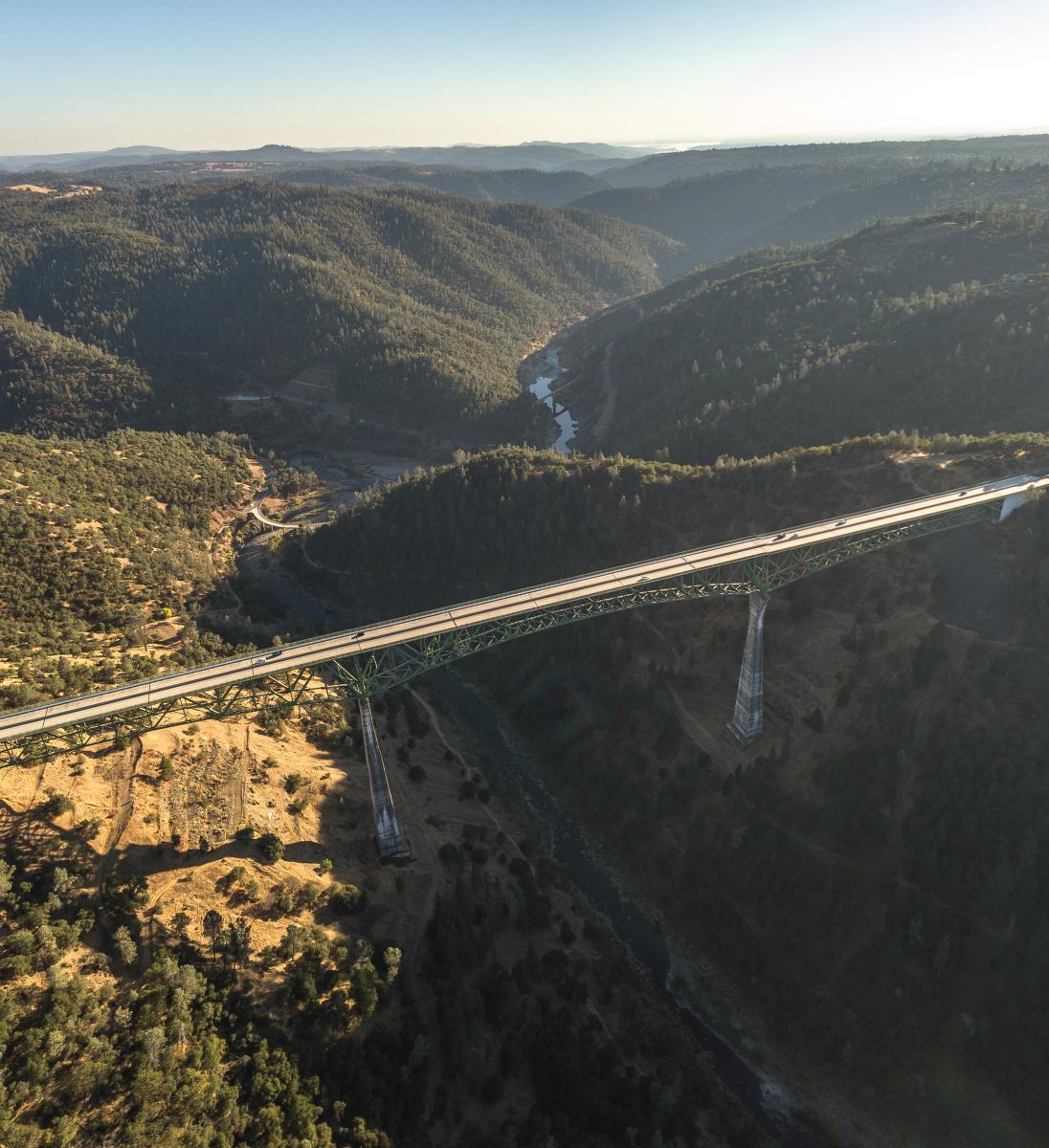
An aerial view of the Foresthill Bridge area where the body of
Zenia Williams was found. (Shutterstock photo)
But those were cases where the killer left biological material — blood or body fluids — at the crime scene. If someone did murder Williams, there was nothing like that found with her. That means the genetically based family tree mapping techniques that famously brought down the Golden State Killer won’t be offering peace to those who loved Williams.
But it doesn’t mean a newer technology won’t.
Investigators and prosecutors with the Placer County District Attorney’s Office constitute one of the handful of law enforcement teams in California currently working with an AI-powered investigative analysis platform called Closure. The detectives using Closure describe it as something akin to a gopher burrowing at hyperspeed through mountain-high layers of strata — that metaphoric terrain being terabytes of potential video, audio and digital evidence — and then re-emerging within minutes or seconds with viable leads.
In this analogy, it does not mean that the detective takes the gopher’s word for what it found, but rather the gopher shows the detective the exact spot on the mountainside to dig for the evidence and verify it.
Placer County District Attorney Morgan Gire says Closure has already helped solve crimes and shore up prosecutions in his jurisdiction, though he stresses it could also be a game-changer for breaking nearly impossible cold cases.
“This doesn’t replace investigators or prosecutors — the criminal justice system will always be centered around human judgment — but what it can change is the speed and efficiency at which we analyze the data,” Gire tells Comstock’s. “Cold cases present their own unique challenges, and there are times where we don’t have a DNA profile of the perpetrator to work off. In those instances, finding evidence is like looking for a needle in a haystack. But Closure can actually organize every needle in that haystack.”
How AI helps prosecutors with ‘overwhelming’ amounts of evidence
When Placer County Deputy District Attorney Rick Miller walked into the historic courthouse in Auburn last June, television crews from Dateline NBC and 20/20 were waiting for him, while British documentary film producers were messaging newspaper reporters in the hallway. It was all because Miller would be giving his opening statement in the trial of Daniel Serafini, a former Major League Baseball player accused of shooting his mother and father-in-law in a callous ambush, murdering one and permanently disabling the other. (Serafini’s mother-in-law, Wendy Wood, initially survived the attack, but later took her life.)
What unfolded was a seven-week trial during the summer of 2025, followed by another four weeks of post-trial hearings in the winter of 2026.
One of the reasons Serafini’s court saga dragged on for so long was the sheer amount of evidence that was introduced. This included scores of cellular tracking points from multiple phones across two states, still-frame photos and video clips captured by numerous public and private cameras in both California and Nevada, drone footage, satellite maps, financial records, voicemails, scrolls of text messages and 100-plus hours of recorded jail phone calls.
By the time the titanic court showdown was nearing its end, Miller was using Closure to help review and organize that deluge of evidence. The prosecutor won every aspect of the trial and post-trial hearings. Serafini was found guilty and sentenced to life in prison without the possibility of parole.
“This doesn’t replace investigators or prosecutors — the criminal justice system will always be centered around human judgment — but what it can change is the speed and efficiency at which we analyze the data.”
— Morgan Gire, Placer County district attorney
But the voluminous amount of court exhibits that were handled in Serafini’s saga was not an outlier, nor did it have anything to do with the defendant being slightly famous in the sports world. Investigations into major crimes are increasingly data-driven and complex because of the tech-dominated landscape Americans now live in.
“We are dealing with a reality that, within our cases now where we are faced with an enormous amount of information, the data surge in our investigations is oftentimes overwhelming,” says Gire, who supervised the Serafini prosecution. “It’s not uncommon now that we have terabytes of information on large investigations. All of that requires someone having to go through it.” (One trillion bytes, or terabyte, is roughly equivalent to 100 billion to 200 billion English words of plain text.)
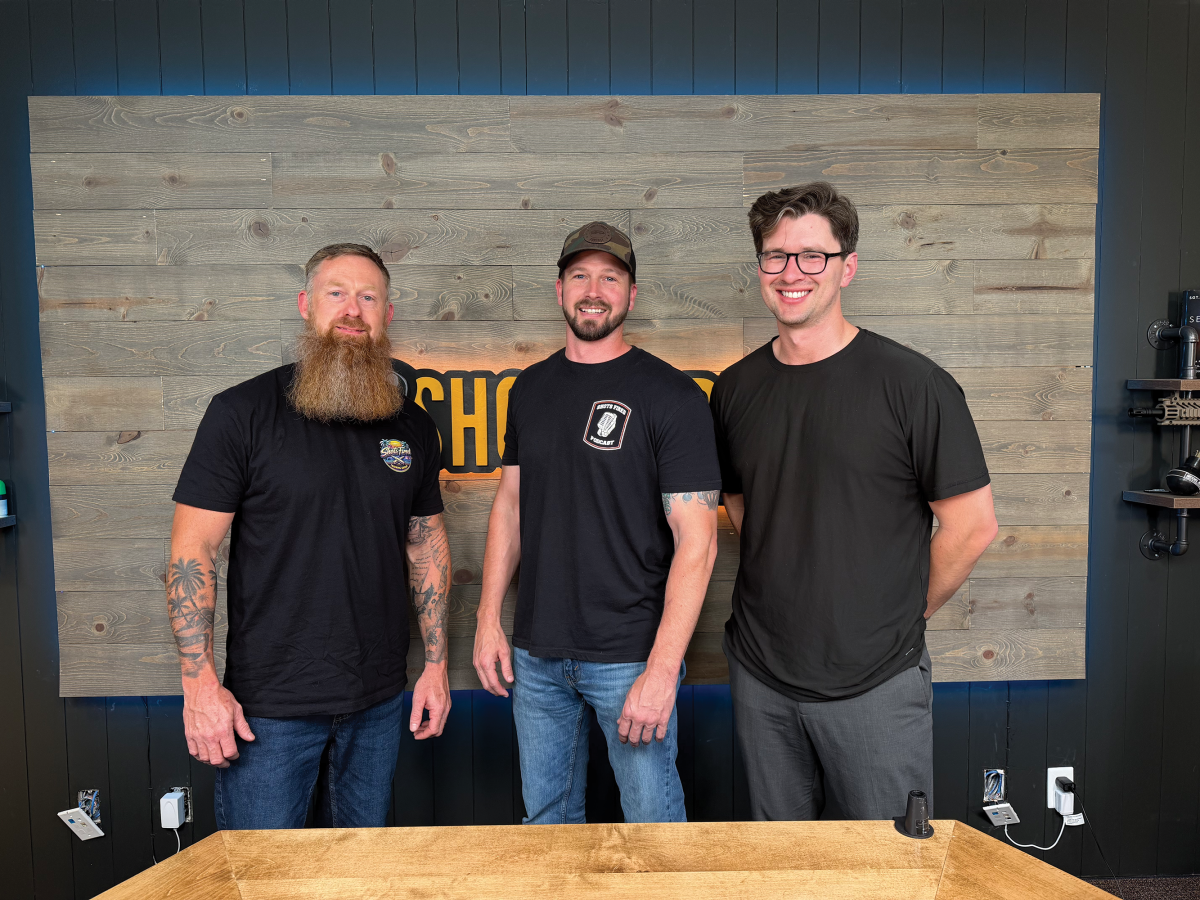
From left to right, Mark Redlich, a former Sacramento police SWAT
operator, and Kyle Shoberg, a sergeant with the Citrus Heights
Police Department, hosts of the popular law enforcement podcast
“Shots Fired,” with Aaron Zelinger, co-founder and CEO of
Closure. (Photo courtesy of Closure)
One person who wanted to help the “long arm of the law” get a lot longer on that front was Aaron Zelinger, Closure’s co-founder and CEO.
Zelinger grew up in the Bay Area, the brother of a mob prosecutor in New York City and grandson of a Santa Clara County judge. He attended Stanford University, where he studied symbolic systems within applied computer science. After a lengthy stint in defense contracting, Zelinger started meditating on how he might use his data expertise to assist law enforcement. He did ride-alongs with police officers and talked to detectives to understand what their challenges were.
“They were mentioning that the amount of evidence in their cases had exponentially grown over time,” Zelinger recalls. “What used to be just a few gigabytes of data was now terabytes, and the number of sources and types of evidence were vast. And for each type, whether it was jail communications, social media data or cold case files, there was a separate system required for them to analyze it.”
Zelinger started working with a handful of detectives and prosecutors in California to develop Closure, specifically ensuring it was a secured platform that operated by Criminal Justice Information Systems standards, also known as CJIS standards. CJIS is a strict compliance framework set forth by the FBI for storing, encrypting and accessing sensitive personal information related to investigations. Zelinger emphasizes that the purpose of Closure has never been to replace the judgment of a human investigator.
“Critically, this allows law enforcement to easily find information in the raw evidence, but at that point, they’re not relying on AI, but instead relying on their own eyes and ears,” he says.
In late 2025, Zelinger’s company began contracting with a handful of law enforcement agencies that wanted to try using it in real-time. One of those was the Placer County District Attorney’s Office, whose DA investigators work in coordination with Placer County sheriff’s detectives on, among other tasks, cold case murder probes.
If fed the relevant information, Closure can quickly identify every witness, suspect and associated person who’s ever been linked by investigation to a specific murder victim, helping a detective search for proverbial connective tissue between any of those individuals and the crime, particularly in ways that would have been hard to see before.
“If we have a 30- or 40-year-old case, there could be everything from typed police reports and scratched, handwritten notes, to different kinds of information recorded in various forms,” Gire says. “All of that can now be put into Closure, which will initially analyze it much more efficiently than a new investigator to the case who’s trying to go through each piece of evidence. I think Closure will only develop as a better and better tool for cold cases as time goes on.”
Backup for smaller agencies
Del Norte County is one of the most rural jurisdictions in California. A.C. Field started as one of the sheriff’s deputies 30 years ago, eventually working his way up to chief district attorney investigator. Law enforcement agencies in Del Norte are relatively small in terms of staffing, but the standards its detectives and prosecutors have to abide by when bringing cases to court are just as high as any other county in the state. In essence, they have to aim for maximum public safety with minimal resources.
Crescent City is one of the larger towns in Del Norte County,
California. (Shutterstock photo)

That’s why Field and his fellow investigators at the Del Norte District Attorney’s Office decided to give Closure a try. They say there were instant results.
“I’m working on a case right now for a suspect who was arrested in December of 2025 and has made over 700 phone calls from the jail,” Field says. “There’s no way I’m going to be able to sit and listen to all of those calls. But with Closure, in less than 10 minutes, it had gone through the first 100 calls and found the exact spot where that suspect was asking someone else to wipe his phone clean and destroy evidence in the case.”
So far, the biggest win in court for Del Norte’s DA investigators involved a defendant who was initially arrested on suspicion of violent crimes against a female victim. Field got a warrant to search that suspect’s cellular data, but he couldn’t access it because it was on an iPhone. Law enforcement doesn’t like to advertise this, but all the warrants and judges’ signatures in the world do not change the fact that iPhones are hard to break into. However, the suspect started making phone calls from jail as the criminal probe against him unfolded.
“I put 30 of his phone calls into Closure, and within minutes it spit back the pass code to his iPhone,” Field remarked. “I don’t think I ever would have gotten that.”
Field says legally accessing that suspect’s iPhone led to the discovery of far more evidence, which in turn caused a jury to find him guilty of an array of charges, including various forms of sexual assault and witness intimidation.
“Before Closure, dealing with jail calls was a second-for-second type of thing,” Field says. “Every minute a suspect is on the phone is how many minutes we investigators actually had to have headphones on.”
Based on what he’s seen so far, Field is another strong believer that Closure has powerful potential for cold cases.
“I really believe this is a force multiplier for us,” Field says. “When you look at what a resource Closure has become to our agency, it’s truly amazing.”
–
Stay up to date on business in the Capital Region: Subscribe to the Comstock’s newsletter today.
Recommended For You

How the California Government Escheated Its Way to $13 Billion of People’s Money
Looking into the loopholes of California's unclaimed property law
The state’s unclaimed property law is supposed to reunite abandoned assets with their owners. But another aim has long since taken over, say experts and attorneys for victims.
The Way We Work: Sacramento County Sheriff Jim Cooper
A glimpse into the daily life of the top law enforcement officer for Sacramento County
The biggest challenge of his job? “It never turns off,” says Sheriff Cooper. “It’s always on. My phone rings at all hours of the day and night.” The good news is that he’s wired for this. “I enjoy what I do,” says the sheriff. “I’m not a type-A personality. I’m a type-AAA personality. I can go. I don’t have an off switch.”
Digital Detective
A State Bar opinion on electronic discovery underlines a new reality — lack of technology competence isn’t just a competitive risk, but an ethical one
From texts to photos to emails, every modern law case involves some sort of e-discovery — so why are lawyers still failing to do it?