


This story is part of our October 2026 issue. To read the print version, click here.
This brings us to the story of a magnificent tree that was killed by our lack of support for better outcomes.
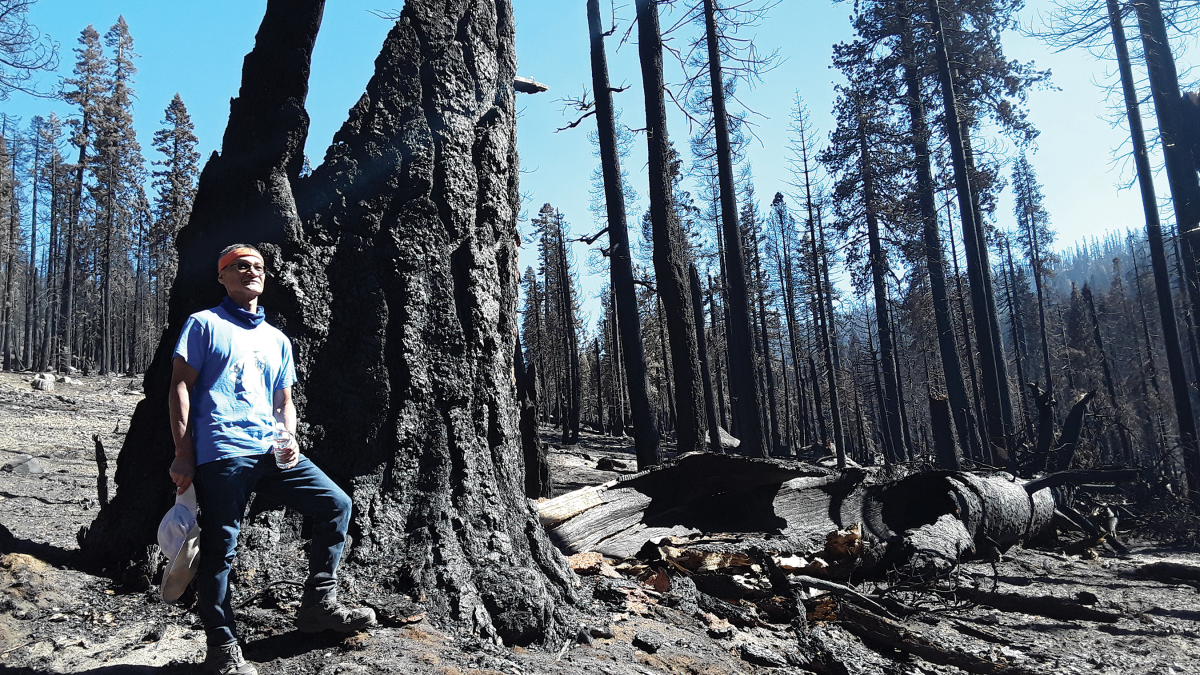
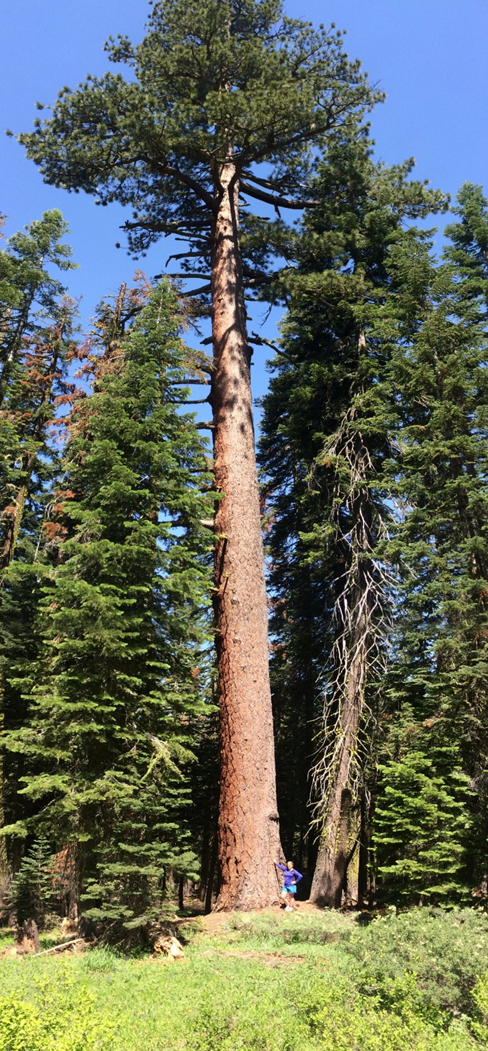
Its charred hulk lies sidehill on the mountain, waiting for the decades to return it to the soil. Before the 2021 Caldor Fire, the massive Jeffrey pine stood proud and tall in Sayles Canyon, whose chilly waters feed into the South Fork of the American River, flanking the Tahoe Basin.
The great tree thrived until five summers ago. Locals and hikers had long marveled at its 200-foot height and massive girth, 7 ½ feet in diameter. At 6,650 feet above sea level, the ancient wonder had multiple names. I always called it Methuselah, because I knew the tree was very, very old like its Biblical namesake. There are other Methuselah trees — most notably a bristlecone pine in Inyo County — but this was my Methuselah, by far the largest in the Canyon and for miles around.
The Caldor Fire incinerated its sylvan home with preventable but unprevented rage; a void in our collective character, visited upon the earth; a touching of the land that is not OK.
Centuries before, Columbus was at sea while a youthful Methuselah was reaching for the sky. By 1776, its dominance on the landscape was well established. Nisenan people would have known of the tree, whose thick bark withstood dozens of periodic, low-intensity wildfires before our modern era of industrialized fire suppression.
The burnt Jeffrey pine before the fire. (Photo by Dave Dealey)
Prior to the Gold Rush, Nisenan and Washoe people lived with frequent meanderings of fire on the land. In the seasonally dry West, tribal management practices included widespread burning to reduce risk, facilitate hunting and promote desired vegetation. The early forestry profession — modeled on European roots — scorned these practices. Progressive era managers demanded strict fire suppression. Over time, the natural, if unintended, consequence has been the densification of flammable woody biomass.
Like music, fire has rhythm in California and across much of the West. Efforts to stop the music have only made the drum beat louder and more subversive. Today humanity is busily adding to the cacophony with the combustion of fossil fuels, raising the seething anger of dry summer heatwaves.
Which brings us to Methuselah and indeed all living things in Sayles Canyon on Saturday, August 28, 2021, the day before the Caldor Fire exploded east, flanking the Highway 50 corridor and racing towards Echo Summit and the Tahoe Basin. Caldor had first sparked two weeks beforehand, 30 miles west in the Sierra foothills. Now media reports cheered firefighting success at the nearby hamlet of Strawberry. Meanwhile, flames were licking over the divide above Lover’s Leap, ready to make their run the next day.
Sayles was a deeply timbered slice of the Eldorado National Forest. Locals and nearby cabin owners had supported fuel treatment efforts in the near vicinity of structures but otherwise frowned upon larger-scale operations. They thought touchless nature was a better bet. This distrust of forestry reflected anti-logging attitudes dating back to the Timber Wars of the 1990s. Preservationists had won that struggle; the log trucks and lumber mills had gone away.
Methuselah waited in a sea of dry vegetative matter. On its uphill side at ground level, it had a triangular fire scar, commonly called a catface. Dendrochronology — the study of fire scars and tree rings — has established that prior to modern fire exclusion, Sierra forests burned at intervals averaging between 8 and 12 years apart. These burns weren’t just indigenous fires; they were also lightning-sparked blazes left free to wander as they pleased.
But this was long ago. Sayles Canyon had now missed many burning cycles, steadily accumulating extra trees, downed wood and surface debris.
And so the fire came on. Temperatures exceeding 2,000 degrees Fahrenheit blasted Sayles and the Sierra-at-Tahoe Ski Resort. Before giving out near the Nevada border, Caldor would cross the Tahoe Basin and complete something previously unthinkable: a full transect of John Muir’s beloved Range of Light.
Methuselah’s catface likely ignited first. It had been scorched before, but never like this. Flames ate inward. After many hours, if not several days, its dense core was gone. The ruined giant twisted on a useless rind, coming to the ground with a shudder that in human terms was a sigh.
And today there’s just us, holding a mirror. We widen our view to the broader Sierra, the Trinity Alps and beyond. Megafires display the fruits of hands-off activism. We see widespread incineration of critical wildlife habitat, grossly degraded soils and steadily declining recreational opportunities. Oceans of dead trees that could have provided wood products, jobs and revenue for reforestation. Massive chunks of native timberland gone to brush.
Forest management solutions are available: thinning, chipping, prescribed burning and even some logging. Study after study has confirmed the effectiveness of these methods in modifying wildfire outcomes. Public awareness and support are on the rise.
Most important, though, is for us to tune into nature’s music. We must learn to live with fire, knowing that flames will touch the dry land as they always have. We can touch the land, too. We can wrestle with those flames before they ever exist. We can influence what happens in our greater world, in the vastness beyond the tidy confines of Farm to Fork.
Methuselah, sidehill on a hurting mountain, wants us to talk.
William Wade (Bill) Keye is a forester, educator and writer. A graduate of UC Berkeley and Sacramento State, his award-winning perspectives on California forestry issues have been widely published, including by the Sacramento Bee and San Francisco Chronicle. Keye is a former chair of the Northern California Society of American Foresters.
–
Stay up to date on business in the Capital Region: Subscribe to the Comstock’s newsletter today.
Recommended For You
There’s a Cool Cathedral of Trees Just a 2-Hour Drive From Sacramento
Sonoma County’s redwoods have survived over 1,000 years thanks to natural armor and other adaptations
There are some large, beautiful redwoods at parks closer to Sacramento, including Henry Cowell Redwoods State Park, near Santa Cruz, and Armstrong Redwoods.
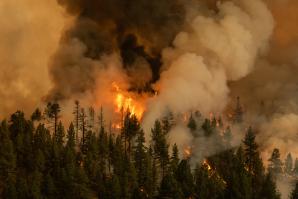
Earth, Wind and the Fire Next Time
Climate change is a factor in California’s rampaging wildfires, but not the only one
Due to human influence, three primary ingredients of wilderness fires are on the rise: the accumulation of biofuels in the forest, rising heat of the planet as a whole, and an ineffective political system of fire management.
Maples, Dogwoods and Quaking Aspens: Where to See Native Fall Colors Near Sacramento
This writer’s 'grand tour' starts near Lake Tahoe and ends in Bishop
One of the great pleasures of living in Northern California is watching seasons change multiple times as they move between the higher and lower elevations.
How the National Weather Service Helps California Through Fire Season
Local offices in Sacramento and Hanford were critically understaffed, but pending legislation aims to prevent this from happening again
As California headed into fire season, two National Weather Service offices covering much of the Central Valley struggled with unprecedented vacancies — forcing service cutbacks and backup support from neighboring stations. What does this mean for the future of weather safety in California?