


This story is part of our January 2026 issue. To read the print version, click here.
To anyone outside Sacramento’s Catholic schools enclave, it would be easy to characterize the conflict at Jesuit High School as a tempest in an ablution cup. But the decision to turn the all-boys Catholic institution, which first opened its doors in September 1963, into a “co-divisional” high school — meaning a majority of learning experiences would be taught separately between girls and boys in years nine, 10 and 11 and in mixed classes in grade 12 — has provoked protests and heated arguments. There have been threats of litigation and, even more dramatically, a warning by more than one protester that the matter will be referred “to the Vatican.”
On the surface, the issue seems mainly pragmatic: Schools throughout the region, Catholic and secular, have been battling a slide in enrollment figures for a variety of reasons — dropouts, hard-to-reverse COVID-19 disruptions, a slowdown of building new communities in the Capital Region to attract families with school-age children — and a cooling of enthusiasm for gender-restricted schools in particular. So why not open the doors to children of both sexes and, presumably, watch the numbers double, or at least increase?
It’s not that easy. For example, if students who had planned on attending St. Francis High School, a girls-only Catholic institution, now have the option of going to a co-divisional academy whose religious basis would seem to be identical, what would happen to St. Francis’ reportedly diminishing student population?
John Moran, president of St. Francis High School for the past seven months, acknowledges there’s been a decline in enrollment of several hundred students “in about the past five years, from as many as 1,000 to our current figure of 700 students. But we’ve stabilized our budget and are poised to grow next year.”
Asked if Jesuit’s decision to begin admitting girls in 2027 might siphon off some of the growth he envisions, he says that even if Jesuit’s numbers grow, “it won’t result in a decline for us. I wish them and every Catholic school success. We need more Catholic schools, not fewer. Just like the thin line between lawfulness and lawlessness, there’s a thin line between godliness and godlessness.”
John Moran is president of St. Francis High School.
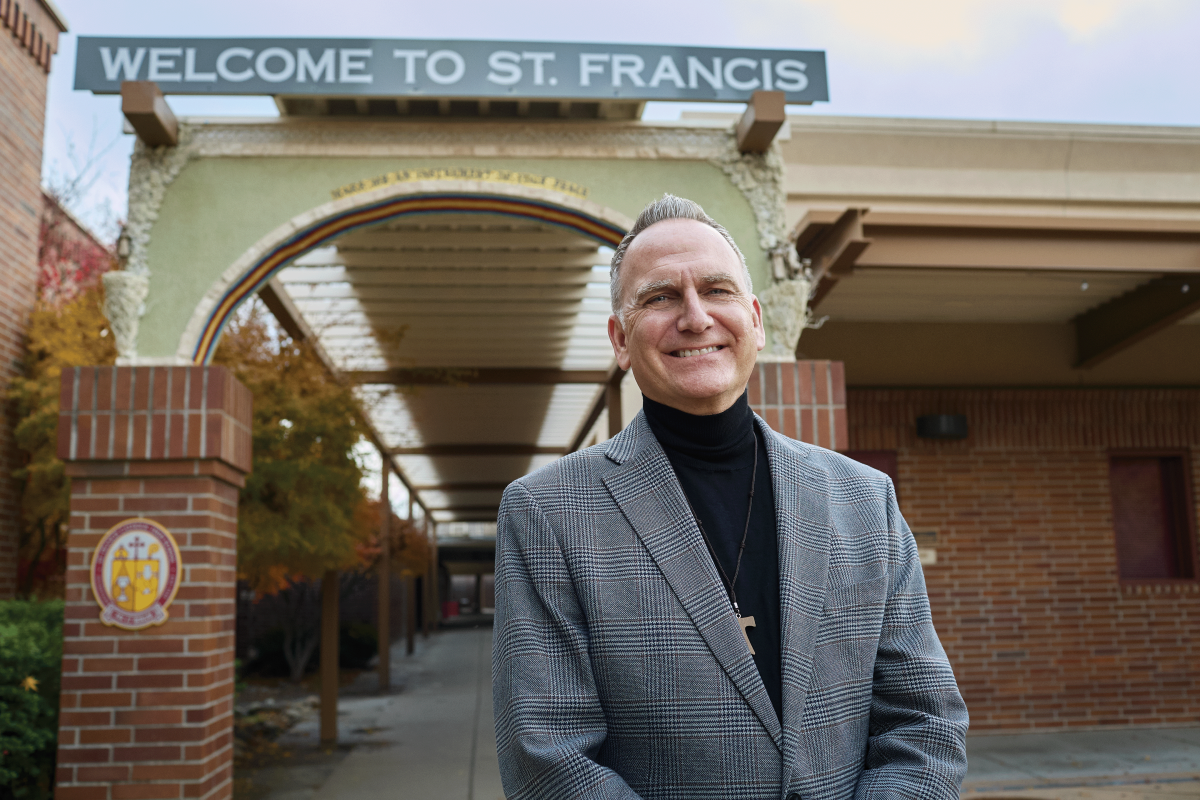
Boston transplant Moran — who holds a doctorate in education from the University of Southern California with an emphasis on K-12 leadership — came to St. Francis after a three-year stint as president of Junipero Serra High School in Gardena, a Southern California bedroom community. He says there’s “no competition” between St. Francis and Jesuit “or among any Catholic schools, for that matter. Religious schools are delicate organisms, no doubt about it. But we’re not in decline on any level.” He points to the fact that St. Francis’ cash flow “is very strong. We have no debt, strong savings, and last year landed close to a million dollars in the black. Some media outlets have reported we were that much in debt. Completely false.”
St. Francis, like most private schools, gets money from “a combination of tuition, fees, donations and grants. We raised 40 percent more during November’s Big Day of Giving than the previous year with our SupportHer campaign.”
Related: Why an All-Boys Mission Still Matters
Moran answers to a nine-member board of trustees but says that number “may very well grow in the next couple of years.” On the subject of the decline of enrollment figures that he says is turning around, he attributes it to COVID-19 and “the misperception that our school was either about to merge or about to close. But let me tell you something: We’re not closing, and we’re not going coed. What we’re doing is heading boldly into the future, something I devoutly wish for Jesuit and all of the country’s Catholic schools.”
One of Moran’s colleagues and, recently, someone he refers to as “a good friend,” is Chris Alling, the president and chief executive officer of Jesuit High School. Alling returns the compliment. “I just had dinner with John the other night,” he says.
“It won’t result in a decline for us. I wish them and every Catholic school success. We need more Catholic schools, not fewer. Just like the thin line between lawfulness and lawlessness, there’s a thin line between godliness and godlessness.”
— John Moran, president of St. Francis High School
Alling, the father of three grown children — all of whom attended a Jesuit high school in a different city — has been on the job since July 2023. By the time he arrived here, he says, “our board of trustees was already strategizing on how they might handle Jesuit High’s enrollment, which declined gradually over the past 10 years. They did a lot of research.” Alling says reasons for the drop-off included “tuition hikes and the growth of other options, such as public schools and charter schools.
There were discussions on merging with other schools and apparently some very frank discussions about what that would look like.” Ultimately, Alling says, the decision to expand the student population “made the most sense” to “preserve financial stability. Despite the rumor flying around, we’re not in a financial crisis.” Nor, he claims, has the school been accepting multi-million dollar “conditional donations” to preserve its gender-restricted model.
And so this past Oct. 4, it was announced that the school would begin preparing next year for the enrollment of young women in the 2027 school year. The protests began immediately. Elizabeth Sands, a school spokesperson, says of an alumni base of more than 11,400, Jesuit received emails “from approximately 50 alums, and sentiment among those was split 50-50.”
“What is wonderful,” she continues, “is that many have shared their support and excitement for this innovative future for Jesuit. We’re especially grateful to alums who supported this decision and then made even bigger gestures of support through their donations.” And, she adds, “Since our announcement, we’ve had great attendance at our reunion and homecoming weekend, as well as other on-campus events.”
Not everyone is a fan of the scheduled changeover. One particularly passionate letter, signed by “David Grega ’03,” attempts to make the case that Jesuit’s upcoming transformation violates its founding principles. “Sixty-three years ago the Sacramento community founded Jesuit High School with a clear and profound mandate: to form Men for Others through intellectual integrity, spiritual examination, and profound brotherhood,” the widely circulated email reads. “Now that same community watches those pillars crumble — not from external forces, but from a fractured foundation within.
“In early October 2025, the president of my alma mater announced that the Sacramento region’s only all-boys high school, the beating heart of Catholic life, would accept girls beginning next year in a co-divisional model (with AP/honors classes being coed immediately) and become fully coeducational by 2030.”
Alling says 2030 is an “aspirational” but possible date. He says that Jesuit currently has 929 students and that the 53-acre campus will undergo a variety of improvements — such as converting office space that had once been classrooms back to their original purpose and modifying locker rooms — to welcome as many as 200 girls into the ninth, 10th and 11th grades in just over a year-and-a-half.
Two protesters contacted by the magazine were willing to share their views but wished not to be identified. One says, “My neighbors are kind of mad at me,” and the other says in a text, “You people in the media are portraying us as crazy, so no thank you.” Their reasons for opposing the transition: “We can’t start abandoning all of our traditions,” says a mom who considers herself a “spiritual but not actively practicing Catholic.” “I went to Jesuit and I turned out to have strong values, which I’d like my boys to have,” says the father of one current student and one upcoming one.
Jesuit’s board of trustees is currently chaired by Kelly Brothers, a wealth and investment advisor, former news anchor and frequent contributor to KCRA-TV and KFBK radio. He is the father of four — his two daughters attended St. Francis, and his two sons attended Jesuit, where Brothers also graduated in 1982. He says the decision to go co-divisional was “a long time coming, as we watched enrollment trend downward over the past 15 years.
Related: Grass Valley Museum Tells Untold History of Mount Saint Mary’s Convent and Academy
“In 1982, when I graduated, there were six single-sex Catholic schools in Sacramento, and Sacramento itself was one-third of its current size,” he says in a recent interview. Brothers, who’s been on the Jesuit board for six years and is in the final half of his two-year term as its chair, says the protest about the coming change “has been relatively small but vocal. Some alumni feel we’re not honoring the school’s traditions, and some parents of incoming freshmen are worried about what their kids’ experience will be.”
He says he opted to fully support his alma mater’s change “because it’s about survival. What I feel good about is that we made this decision in a strong economy, not in a panicky way during a recession, because another recession is always around the corner.”
Asked if any of the protests are likely to change the board’s collective mind, it’s a simple “no” from CEO Alling. “The decision is final,” he says. We’re doing this to ensure the survival of the school and its values well into the future.”
–
Stay up to date on business in the Capital Region: Subscribe to the Comstock’s newsletter today.
Recommended For You
Why an All-Boys Mission Still Matters at Jesuit High School | Opinion
A 1989 alumnus shares his thoughts on the Catholic high school's plans to accept female students
For 60 years, Jesuit High School has done something both simple
and profoundly difficult: It has taken teenage boys — forces of
chaos, appetite and uneven judgment — and formed them into
disciplined, reflective, service-oriented young men.
Sacramento City College Was Once the Only College Between Stockton and Chico
Step inside the 108-year-old Land Park legend
“I’ve been here more than half my life,” says Sac City President Albert Garcia. “I love the history of this college. It gives everything we do here a richer context. Don’t forget, for many years, as far as colleges in the area, we were it. Just as we began by being part of a high school campus.”

How Capital Region Schools Are Training Students for Technical Skills Careers
Community colleges, high schools and private institutions offer pathways to jobs in the trades
Around the Capital Region, technical and trade programs in high schools, in community colleges such as Cosumnes River, American River, Sac City and Sierra, and in stand-alone entities such as UTI, are flourishing.

Star Power and Flashy Hires Are Kicking Off Sacramento State’s Sports Season
Lakers great Shaquille O’Neal and Sac Kings star Mike Bibby are among the personalities drawing attention to the sports program
Sacramento State’s sports teams have endured many lean
years. But the institution, which debuted its original sports —
basketball, baseball and tennis — in 1948, has embraced a
controversial change.