


This story is part of our February 2026 issue. To read the print version, click here.
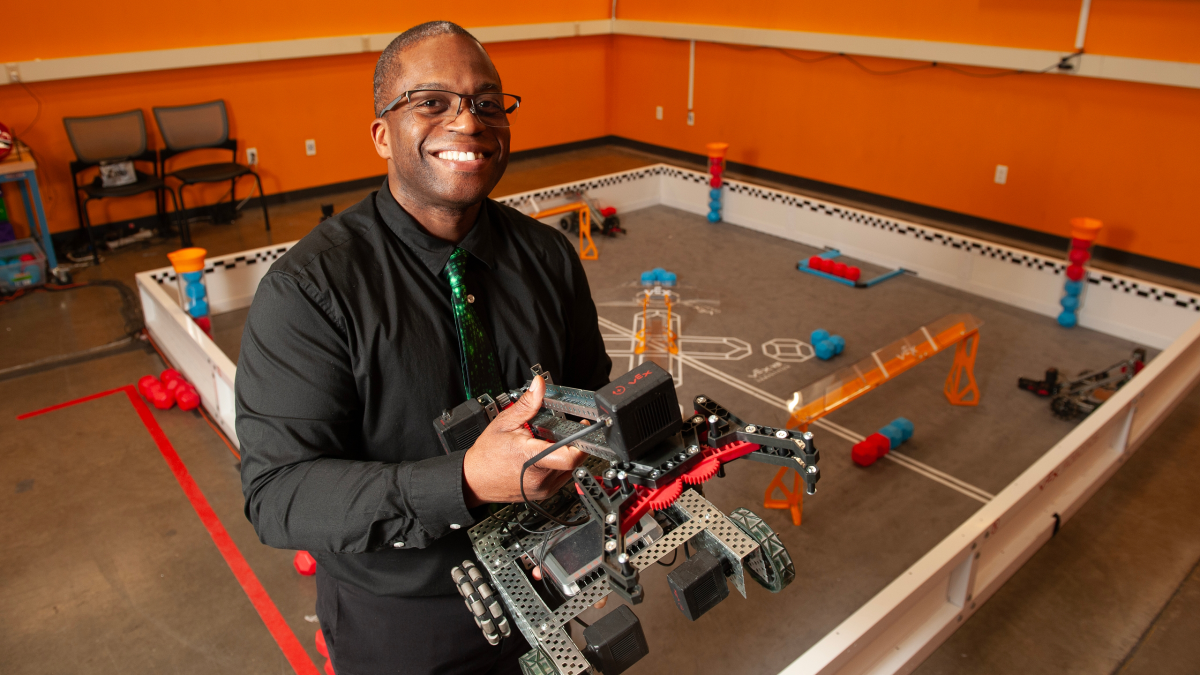
In a corner of the San Joaquin County Office of Education building in Stockton, a FabLab, or fabrication library, provides hands-on, experimental learning experiences for groups of students from around the region.
“It’s full of equipment and inventions and exhibits to inspire kids to want to work in the STEM fields. It’s full of bright lights and colorful things that move and react and make noise. Wearable technology, AI. We have lots of Legos and a lot of stuff we’ve engineered to work with Lego kits,” says Stephen Callahan, director of the lab. Students can use microscopes and thermal imaging systems here; they can dismantle and reassemble computer motherboards and build Lego controllers for video games.
Callahan has an irrepressible enthusiasm as he discusses the FabLab and how young children respond when they engage with its exhibits, especially those that explain how AI works and what it can accomplish. “Students come in and learn robotics, learn to code. We have musical instruments, including stuff we’ve made, so students can engineer new ways to make sounds. I do want AI to be demystified. We want students to understand how the systems work.”
YouTube videos that Callahan posts from the FabLab include simulated demonstrations of a bear trap he has designed using AI-based pattern recognition libraries, which utilize the same principles as the Venus flytrap carnivorous flower, as well as a light system that can be trained to change colors when participants give it the thumbs up or the V-for-victory sign, commonly known as the peace sign.
Callahan’s work isn’t limited to the FabLab. He is also an “ambassador industry K-12 partner” for the Northwest AI Hub, run out of the engineering department at UC Davis. In that capacity, he helps coordinate middle school summer camps where students study bioengineering, aerospace technology and other cutting-edge AI-infused sciences.
A new tool in the workforce
As the artificial intelligence revolution picks up speed, schools and universities around the Capital Region are racing to use AI as a tool to prepare their students for a workforce in which AI plays an increasingly prominent role. AI is also being used for ESL (English as a second language) students for whom automated, rapid translation software is a boon, for those with learning disabilities and for others who have struggled in traditional classroom settings to keep up with their peers.
Some are embracing the new technology largely uncritically, regarding it as a tool that can speed up teaching processes, serve as a 24/7 hub for advice and be used as a powerful tutorial-accelerant for overworked teachers and professors. Sacramento State’s administrators tend toward this end of the spectrum.
Jean-Francois Coget, dean of Sac State’s College of Business,
says AI is going to transform the work world. He says 60 percent
of jobs are going to be changed by AI in the next five years.
(Photo by Gabriel Teague)
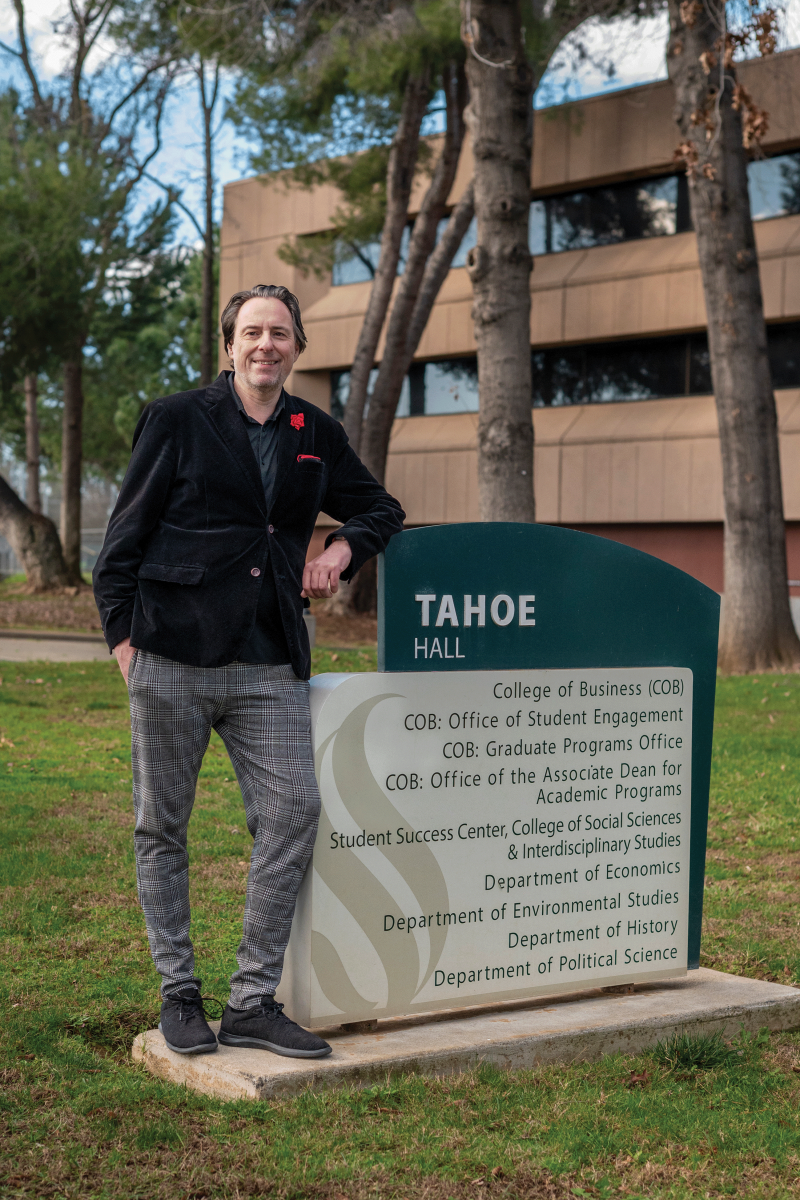
Coget, a lean man with a thin, gray goatee and a head of thick, black hair, enthuses about the possibilities of AI. He recognizes that if it can write essays for students, professors are going to be forced to change the way they teach and grade students. But he sees that, generally, as a positive, akin to the way in which math classes were altered by the introduction of the electronic calculator. “You’ve liberated your limited cognitive capacity for other things,” he says. “If you use AI to write an essay, your essay should damn well be better than if you didn’t use AI. Greater tools, greater expectations.”
Coget’s colleague, Joseph Taylor, the Management, Information Systems and Business Analytics department chair at Sac State, says, “AI is dramatically changing the workforce — and nowhere is that more evident than in entry-level roles,” which is forcing universities to change their emphases in many of the courses they teach. As an example, he discusses freshman-level introduction to programming classes, which in the past taught students to write and debug basic computer programs. Now, AI can perform those roles, so the classes are instead focusing more on how to use AI to help generate and edit code.
Related: AI in Education: Helpful Tool or Sinister Danger?
“Now that AI does the code writing, we’ve got to move them (students) to the higher level skills more quickly,” Taylor says. “This is not about changing individual classes. This is about reinventing the learning objectives of our programs. The big picture. I do not see any part of the university that’s going to be untouched by AI. All of us need to be reconsidering our learning objectives.”
For Sac State transfer student Josh Wesselman, who is entering his senior year, ChatGPT has become the most crucial tool in his academic life — and one that also spills over into pretty much every other area of his life as well. During all of his lectures, he says, he keeps ChatGPT open, “and I’ll ask it for everything. Sometimes, when I feel I don’t want to disrupt the class, I ask the clarifying question within the AI system. It’s just really cool that the whole academic department is being proactive. It’s the first CSU to really take it on.”
“AI is dramatically changing the workforce — and nowhere is that more evident than in entry-level roles.”
Joseph Taylor, Management, Information Systems and Business Analytics department chair, Sacramento State
Wesselman says that he now incorporates AI into every life decision he makes. When he was recently trying to craft a diet for himself, he farmed the problem out to ChatGPT. Even when he knows that ChatGPT is hallucinating — as when it gave him meal plan information based on prices that, from his work at Trader Joe’s, he knew to be demonstrably false — it doesn’t dent his faith in the technology. “I literally use it for everything,” he explains. “You can talk to it, and it’s like a real conversation. It’s so cool; it’s really amazing.”
Wesselman’s fellow student, Kevin Bali, is also an AI enthusiast. As a management, information systems and business analytics major, he wants to use his AI skills to “go into the workforce and do automation much faster.” He is interested in AI’s applications for human resources, for legal research and other similar workplace needs. Of his studies, he says, “I use it to break down complex topics and readings. I don’t really read too many whole books. If I can manage time better, that’s more studying time for me.”
A cautionary tale
The Sacramento State crew represents one side of the AI-in-education argument. They believe that the positives of the technology overwhelmingly outweigh the negatives. Other educators, however, are not so convinced that AI is an unmitigated blessing. While recognizing that it is here to stay, they are taking a more nuanced approach, acknowledging the dangers that, in farming out an increasing number of tasks to AI systems, the technology can undermine students’ ability to think critically and to nurture their creative sides.
Andy Jones, academic director of Academic Technology Services at UC Davis and a lecturer at the university’s writing center, understands the challenges all too well. “The very work of the university is not only to educate students but to certify that education has taken place,” he explains.
In an era when ChatGPT and other LLMs (large language models) can write essays for students, answer multiple choice questions and even design scientific experiments, it becomes ever harder to measure students’ academic knowledge and to prove to employers that students are coming out of college not only with a degree but with the critical thinking skills that historically have gone with that degree.
Jones argues it is important to modify teaching methods to reflect this shift. Given that AI is now so omnipresent, he says, the academy has to focus on how to use it ethically and explain to students how AI is likely to function in each particular field or discipline.
Instead of pretending AI doesn’t exist, the most successful professors are encouraging students to be transparent about their AI usage and explain how they are using it, rather than hiding its use. Professors are asking students to provide context for their projects rather than simply having AI regurgitate data. They emphasize in-the-field information gathering (which still involves direct human input) as a part of each assignment’s grading structure.
Related: Is Education’s Future Safe — or Artificial?
Many faculty are putting in place handwritten exam requirements to try to end illegitimate AI usage by students. Others are incorporating workshop meetings and in-class exercises into their curricula to similarly limit the ability of students to have chatbots do their work.
“We have to create all-new criteria and grading rubrics,” Jones says, to “reward them for the kind of work that ChatGPT can’t help them with.”
“Writing is learning, and learning is writing,” says Marilyn Derby, the associate director for student conduct and integrity at UC Davis. Students are referred to Derby’s office when lecturers and professors suspect them of using AI in ways beyond those permitted in their classes. Take away students’ ability to write originally, Derby argues, and society as a whole loses out.
UC Davis is now dealing with over 300 AI-involved plagiarism cases per year, Derby says, and that’s likely just the tip of the iceberg. Anonymous self-reporting of AI usage suggests that up to half of their students are now using AI in ways not approved for the classes. As a result, says Derby, many faculty are “feeling very disillusioned, tired, frustrated. They’re here to teach, to inspire. When students are just ‘I want the grade,’ that’s dispiriting.”
University educators increasingly believe that ethical usage of AI has to be taught in the K-12 system before students get into institutions of higher education. A generation of children is growing up with AI as an ubiquitous part of their daily lives, and that gives schoolteachers and administrators a huge challenge to ensure that children, during the most impressionable and vulnerable years of their development, learn how to use AI as a tool rather than letting it take control over their lives.
“Overuse of AI takes away from our capacity for critical thinking and creative expression.”
Nicole Naditz, program specialist for instructional technology, San Juan Unified School District
For Nicole Naditz, program specialist for instructional technology with the San Juan Unified School District, this is all about creating a generation of responsible “digital citizens.” The district has purchased the MagicSchool AI system for teachers and the MagicStudent system for school kids. There are, she says, “very strict guardrails around the student platform” so that it is used as a tool to broaden the scope of the learning experience rather than something that can actually do the academic assignments for the children.
Schools, Naditz says, are going to be the frontline institutions, teaching students how to use AI “in a way that is ethical, responsible, and productive. Overuse of AI takes away from our capacity for critical thinking and creative expression. We’re trying to lead with intentionality. We feel like it’s critically important.”
Derby, swamped as her office is in cheating cases related to AI, continues to believe that the technology remains a mixed blessing. “It has so much potential,” she says. But at the same time, schools and universities will, she thinks, have to step up to the plate far more to stop students from abusing it. “All of these things,” she says, “take resources. And universities are a little strapped these days.”
–
Stay up to date on business in the Capital Region: Subscribe to the Comstock’s newsletter today.
Recommended For You
Is Education’s Future Safe — or Artificial?
Comstock’s president and publisher Winnie Comstock-Carlson weighs in on the future of education with AI.

What the State Is Doing to Help Education
Efforts by California’s government to help students recover from the pandemic go back to its earliest days, with the state investing more than $36 billion to deal with pandemic impacts. The funding has gone to Learning Recovery Emergency Block Grants, expanded teacher recruitment, literacy specialists and much more.
AI in Education: Helpful Tool or Sinister Danger?
Most college professors are wary of it, but others embrace it as a learning advantage
All around the world, academic institutions, from the renowned online Khan Academy through to leading research universities, are grappling with the extraordinarily rapid rise of artificial intelligence systems capable of generating human-like responses to complex questions.
Sacramento-Area Schools are Still Grappling With Academic and Social Recovery From the COVID-19 Pandemic
Around the Capital Region, schools are still working to recover socially and academically from the COVID-19 pandemic. Test scores have been affected, as has school attendance. A new wave of behavioral issues has unfolded, too. Now, a variety of people are working to help students catch up.

Will AI Replace Architects?
As artificial intelligence evolves, architects and designers grapple with how the technology can enhance, but not replace, creativity
Architects are recognizing the advantages of using highly accessible generative AI apps like Midjourney, Claude.ai and Microsoft Copilot to test their design limits for the built environment, but they’re also taking a measured approach on integration and adoption into existing processes.

The Bold Vision of Dr. Luke Wood
Sac State’s new, young president is creating an AI hub, Black honors program, college for foster youth and Combat U
Dr. Luke Wood has set his competitive sights on remaking his university into an institution that can compete academically, not just with other CSUs — he is clear in his ambition to make the beautiful, tree-filled and ethnically diverse campus the flagship university in the CSU system — but with the University of California campuses and other top-tier institutions around the country.